Ripple’s IPO speculation has returned to the spotlight after new comments from SBI Holdings CEO Yoshitaka Kitao suggested the payments technology firm may eventually go public. While Ripple’s leadership continues to reject near-term IPO plans, major shareholders appear prepared to support a listing if the company chooses that path.
SBI, which holds roughly 9% of Ripple Labs, indicated it would commit between $626 million and $1.25 billion in a future public offering. Kitao even projected a possible timeline of roughly 12 years, placing a potential listing around 2038. That long horizon contrasts sharply with growing investor enthusiasm, as Ripple’s private valuation has reportedly climbed from $40 billion to $50 billion within months.
The question for markets is not simply whether Ripple will go public, but what a public valuation would signal for XRP and the broader ecosystem.
Ripple’s $50 Billion Valuation and IPO Positioning
Ripple is now widely ranked among the largest potential IPO candidates globally, sitting behind companies like Stripe and Revolut while ahead of many established fintech and technology firms. A $50 billion valuation represents a 25% increase from the $40 billion level reached after Ripple raised $500 million in late 2025.
This growth occurred despite Ripple leadership reiterating that the company does not need to access public markets. CEO Brad Garlinghouse and President Monica Long have both emphasized that Ripple’s balance sheet remains strong and that the company can fund expansion internally.
Instead of preparing for an IPO, Ripple has deployed capital aggressively. Since 2025, the firm has invested nearly $4 billion in acquisitions across custody, payments, treasury management, and infrastructure. Hidden Road, GTreasury, Rail, and Palisade all reflect a strategy focused on building institutional financial rails rather than pursuing public equity liquidity.
Still, the IPO narrative persists because scale matters. A public listing at $50 billion or more would place Ripple among elite financial infrastructure firms and signal strong institutional confidence in its cross-border payments network and RLUSD stablecoin ambitions.
How a Ripple IPO Could Impact XRP
Ripple equity and XRP are structurally separate assets. Owning Ripple shares would not provide direct ownership of XRP tokens. However, market psychology consistently links the two.
When Ripple gained regulatory clarity in its SEC dispute resolution, XRP price momentum accelerated. Major partnership announcements have historically coincided with price rallies as investors interpret corporate success as ecosystem validation.
If Ripple were to go public at $50 billion or higher, markets would likely treat it as institutional endorsement of the XRP Ledger and Ripple’s broader infrastructure strategy. That sentiment effect could drive short-term price appreciation even though the fundamentals of XRP supply remain unchanged.
At the same time, XRP’s long-term valuation will continue to depend primarily on real-world utility, treasury adoption, stablecoin flows, and institutional liquidity infrastructure.
CoinCodex Ripple IPO Price Prediction 2026–2027
According to CoinCodex’s Ripple IPO price prediction, Ripple’s valuation trajectory through 2026 and 2027 suggests strong momentum following mid-2026 consolidation.
In June 2026, the projected average valuation stands at $118.07. July rises to $127.03, while August accelerates sharply to an average of $143.26. Momentum strengthens further in September, with an average forecast of $168.83. October maintains elevated levels near $166.18 before November moderates slightly to $155.62.
December 2026 projects renewed strength with an average of $177.18. Early 2027 forecasts indicate continued expansion. January shows an average of $203.83, followed by February at $207.87 and March at $204.39. While April softens slightly to $198.79, projections stabilize above $200 into mid-2027.
These projections imply that if Ripple were to pursue public markets, valuation could approach the $200 level under favorable adoption conditions. That trajectory reflects a potential 75% to 90% increase from mid-2026 levels in bullish scenarios.
There are many conflicted opinions on XRP’s long-term potential, as some still consider XRP “not a real crypto” because of its implications in banking. However, XRP could see a significant surge over the long term, with estimates ranging from $2.50 to $9.15 in 2040. Projections for 2050 are even more varied, suggesting maximum prices between $7.32 and $15.70.
What fuels this spectacular growth potential? Factors like regulatory outcomes, market conditions, and potential increased use in financial services all play a role. Let’s uncover the catalysts behind XRP’s predicted ascension and what this might mean for the future of cryptocurrency investing.
Key takeaways:
The resolution of the SEC lawsuit, the launch of a USD-backed stablecoin, and increased adoption by financial institutions could drive XRP price appreciation.
Regulatory clarity and resolution of legal challenges will significantly influence XRP’s price trajectory and market confidence.
Historical growth rates and market dynamics suggest significant long-term potential, with emphasis on cautious, ongoing market analysis.
XRP price history
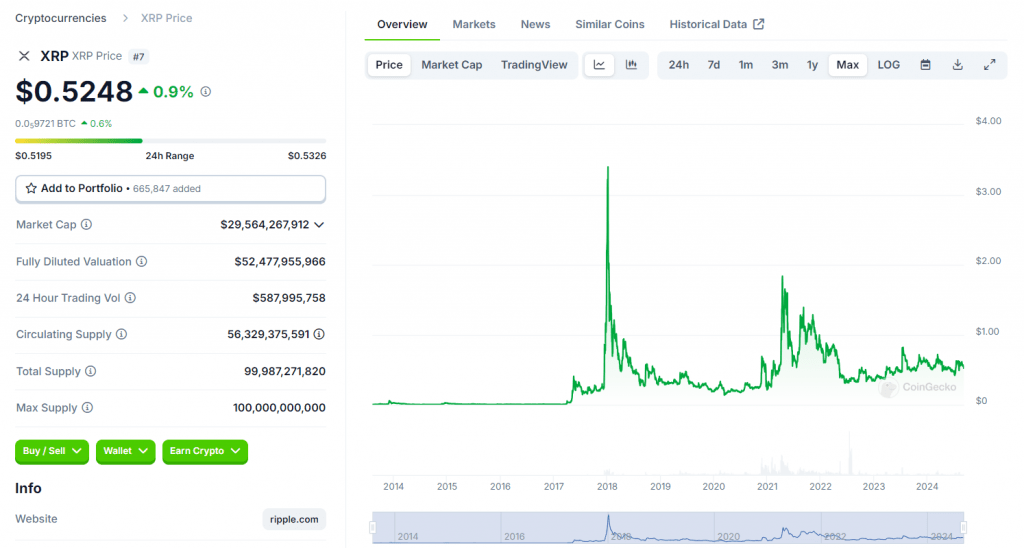
The journey of XRP’s price history is marked by significant milestones and dramatic fluctuations. If you’ve been following XRP, you know it was launched in 2012 at an initial trading price of less than 1 cent. It’s astonishing to see how far it has come, experiencing a surge of over 5,100% from its inception to its current price of $1.44 as of March 2026.
The strongest year for XRP was undoubtedly 2017, where it gained over 35,000%, reaching an all-time high of $3.40 in January 2018.
The road to success was anything but smooth, though. Following the SEC lawsuit announcement in late 2020, XRP faced considerable price volatility, dropping to around $0.20 in 2019 before ultimately recovering.
Despite these challenges, it managed to end 2023 trading at around $0.62 after fluctuating due to market conditions and legal developments. After the SEC dropped the lawsuit against Ripple, the cryptocurrency reached $3.64, though it has been dropping since then, all the way to $1.44 as of March 2026.
These historical patterns are important to understand future price predictions, which suggest a potential range of $2.50 to $9.15 by 2040, and even higher in 2050, based on historical growth trends.
Long-term XRP growth catalysts
When examining long-term XRP growth catalysts, you’ll notice several key factors that could significantly propel the cryptocurrency’s price.
Let’s break down what these are and why they matter.
Firstly, the resolution of the ongoing SEC lawsuit could be impactful. The lawsuit was finally ruled on in August 2024, and although some of SEC’s claims were denied, Ripple was still fined $125 million. Regardless, investor confidence and market acceptance were apparently reinvigorated by the mere fact that the lawsuit was over. Moving forward, it will be crucial to monitor the XRP rich list for any notable changes made by large investors.
Also, Ripple launched a USD-backed stablecoin in 2025, improving liquidity and broadening the use cases for XRP as a digital asset, further driving demand and price appreciation.
Moreover, increased adoption of XRP by financial institutions for cross-border transactions is vital. As more institutions integrate XRP into their operations, demand will increase, supporting long-term price appreciation.
Market dynamics also play a significant role in XRP’s future price. Historical growth projections suggest that XRP could reach a maximum price of $9.15 by 2040 and $15.70 by 2050, driven by market dynamics and adoption rates.
To sustain the long-term growth projections, XRP is already making strategic moves in 2024.
XRP price prediction 2040
Predicting the future price of XRP in 2040 involves considering various growth scenarios and market factors. You need to look at multiple data points and forecasts.
The maximum potential of XRP in 2040 varies significantly among analysts.
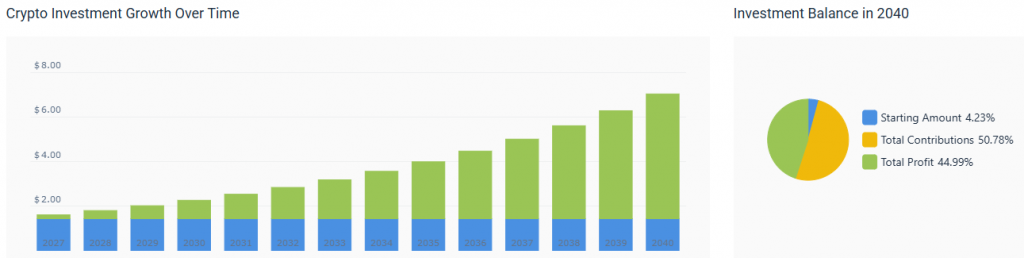
For instance, based on the historical growth of the S&P 500, XRP could reach approximately $7.03, representing a 488% increase from current levels.
Here are key predictions to consider:
Conservative estimates: Some analysts predict a more modest growth, with the maximum price potentially hitting $5.96 and an average price exceeding $4.90. However, these predictions are less commonly cited compared to more optimistic forecasts.
S&P 500 growth model: Based on the S&P 500’s historical ROI, XRP could reach approximately $7.03 by 2040.
Long-term potential: Some forecasts suggest that XRP’s price in 2040 could range from $13 to $22, driven by increasing global trade and partnerships, but these estimates are more speculative in nature and should be taken with extreme caution.
XRP price prediction 2050
When you look at XRP price forecasts for 2050, you’ll notice an even wider range of possibilities (not unlike price forecasts for 2040).
On one hand, based on the historical growth of the S&P 500, XRP could reach approximately a maximum price of $21.81 by 2050.
This bullish outlook depends on the successful resolution of regulatory challenges and increased adoption of the Ripple network.
Market dynamics, including demand from financial institutions and technological advancements, will play a big role in determining XRP’s future price trajectory. If these favorable conditions are met, XRP’s market cap could potentially exceed $3 trillion, similar to Bitcoin’s peak valuation.
Factors influencing XRP price
XRP’s long-term prospects may suggest significant price growth, but understanding what drives this potential is important for investors.
Market dynamics, particularly supply and demand, play a big part in determining XRP’s price. A rise in usage, driven by its fast transaction speed and low fees, can lead to price appreciation. Also, regulatory developments will help increase (or reduce) investor confidence and XRP’s market valuation.
Here are the key factors to consider:
Transaction speed: XRP’s ability to settle transactions in just 3-5 seconds increases its attractiveness for cross-border payments.
Low transaction fees: Averaging around $0.0002 per transaction, these fees contribute to increased demand from financial institutions and users.
Regulatory developments: Future regulatory decisions can significantly impact investor confidence and XRP’s market valuation.
Technological advancements: Updates to the XRP Ledger are expected to enhance scalability and security, which would make XRP more appealing in the competitive cryptocurrency landscape.
Historical performance and trends
Have you ever heard the expression “History doesn’t always repeat, but it does rhyme”? To understand what XRP is likely to do in the coming years and decades, we should also take a look at what it has done so far.
The rollercoaster ride of XRP’s price history shows its volatile nature, yet it also reveals growth and resilience. As you look into its historical performance, you notice that XRP’s price has experienced significant surges and downturns since its inception in 2012, but it’s always managed to survive and come back up.
Initially trading at $0.01, it reached an all-time high of $3.40 in January 2018, only to decline and trade below $1 by 2019.
Examining historical price patterns, you see that XRP’s fluctuations are often influenced by broader market trends and regulatory developments.
Many cryptocurrencies, such as Bitcoin and Ethereum, set new all-time highs in the bullrun in 2021; however, XRP was unable to beat its all-time high from 2018. Was this because of the SEC lawsuit? Possibly. How will XRP perform in the next bull rally? It’s looking pretty decent for now, but nothing is 100% certain.
Despite this volatility, XRP has increased in value and price a lot since its inception, and it serves as a reflection of its growth potential and market interest over the years.
Its price history is a testament to the cryptocurrency’s ability to adapt and evolve, despite facing numerous challenges.
Future adoption and regulatory impact
Looking ahead to the future of XRP, regulatory clarity and adoption by financial institutions will be pivotal factors in shaping its price trajectory.
Here’s how future developments and adoption could influence XRP’s price:
Adoption by financial institutions: Widespread adoption by banks and payment providers could significantly drive up demand for XRP, which would push its price higher.
Technological advancements: Improvements in the XRP Ledger and the introduction of a USD-backed stablecoin could enhance XRP’s liquidity and efficiency and make it more attractive to financial institutions.
Market dynamics: Supply and demand factors, along with broader market trends, will play a crucial role in determining XRP’s price trajectory by 2040 and 2050.
Frequently asked questions
How high can XRP go in 10 years?
XRP’s price in the next decade could range significantly, with some analysts predicting values between $10 and $22 by 2036. A lot depends on the overall market conditions as well as XRP’s adoption.
How much will 1 XRP be worth in 2030?
By 2030, XRP’s price predictions vary widely. Estimates range from $3 to $15. Some analysts remain cautious, suggesting it may struggle to exceed $2.
What would it take for XRP to reach $100?
For XRP to reach a price of $100, it would require a monumental shift in both market conditions and adoption rates. This scenario would likely require XRP to become a dominant player in the financial services sector, possibly as a primary bridge currency for international transactions.
Can XRP reach 20 USD?
Reaching $20 is considered speculative and would depend on several factors, including widespread adoption by financial institutions. While some analysts see potential, achieving this price point would require extraordinary market conditions. While everything is possible, it’s not likely to happen in the near future.
The bottom line
You’ve seen the vast range of XRP price predictions for 2040 and 2050, from a conservative $2.50 to an ambitious $21.81. These forecasts are heavily influenced by market dynamics, adoption rates, and regulatory outcomes.
As you consider investing, remember that XRP’s future is marked by volatility and uncertainty, not unlike most of the crypto market. Its growth potential is significant, but so are the risks. Keep a close eye on market trends and regulatory changes, and as always, stay in control of your emotions and remain cautious.
If you would like to learn more about XRP’s chances of major gains in the future, check out our article exploring if XRP can reach $10,000.
XRP is a unique cryptocurrency that has one of the most devoted communities in the crypto and blockchain space. Although it could certainly be a strong performer in the future, it’s practically impossible for Ripple to reach $10,000.
In this article, we will explore potential future price targets for XRP and explain why you shouldn’t expect XRP to ever reach a price of $10,000, or anywhere close to it, for that matter. We will also consult some XRP price predictions to get a better idea of where the price of XRP could head in the near to medium term.
Could Ripple reach $10,000? Here’s why it’s impossible
The reason why XRP won’t ever reach a price of $10,000 is not complicated – the supply of XRP is simply too large. XRP has a maximum supply limit of 100 billion coins. While not all XRP coins are currently in circulation, the coin still has a substantial circulating supply of 60.92 billion.
Even if we take the more conservative figure of 60.92 billion circulating XRP coins, the implied market capitalization if XRP were to trade at $10,000 would be $609.2 trillion.
To illustrate why this figure is impossibly large, we should point out that the GDP of the United States is $25.4 trillion, and the world’s largest company, Nvidia, has a market capitalization of $4.47 trillion.
To draw a comparison from the cryptocurrency space, we can note that the highest market cap ever reached by Bitcoin was $2.48 trillion. If XRP traded at $10,000, its market cap would be 245 times larger than Bitcoin’s market cap at its historical peak.
So, even if XRP became the world’s largest cryptocurrency, it would be extremely unlikely to hit a price of $10,000. The only realistic scenario for that to happen would be a drastic reduction in the XRP supply through a redenomination or a major burn program.
Although a small amount of XRP is already being burned with each transaction, the burn rate is simply not fast enough to decrease the supply to an amount where $10,000 would be a realistic price target for XRP.
The XRP Ledger has been in operation for over a decade, but only about 12.2 million XRP have been burned through this mechanism. This is only 0.012% of the maximum supply of XRP.
Now, let’s consider various XRP price targets and what they would mean for the market capitalization of XRP. This is a good way to quickly gauge whether a certain price target is realistic or not. We calculated the figures both for XRP’s current circulating supply, as well as its max supply.
XRP price
Implied market cap (60.92B XRP)
Implied market cap (100B XRP)
$0.50
$30.46 billion
$50 billion
$1
$60.92 billion
$100 billion
$5
$304.6 billion
$500 billion
$10
$609 billion
$1 trillion
$50
$3.07 trillion
$5 trillion
$100
$6.09 trillion
$10 trillion
$500
$30.7 trillion
$50 trillion
$1,000
$60.9 trillion
$100 trillion
$5,000
$304.6 trillion
$500 trillion
$10,000
$609 trillion
$1 quadrillion
When it comes to speculating about the potential future valuations of altcoins, we believe that using the historical market cap of Bitcoin is the best idea since it’s a benchmark that has already been demonstrated as possible for a crypto asset to achieve.
To reach Bitcoin’s historical market cap peak of $2.48 trillion, XRP would have to trade at a price of $40.7 (assuming the current circulating supply of 60.92 billion XRP coins). We believe that this is the upper bound of what is possible for XRP to achieve, although it’s of course still unlikely, as it would require a 70.2x increase from the current price of XRP, which is $0.58 at the time of writing this article.
XRP price prediction for 2026 & 2027 – How high can XRP go?
According to our XRP price prediction, we can expect to see a decline in the price of XRP in the short term. The forecasted bottom is $1.44, which is expected to be hit towards the end of February 2026.
However, the medium-term prospects are much more promising, at least as far as the price prediction on CoinCheckup is concerned. XRP is forecasted surpass the $2 price level and reach a price of $2.29 in August of 2026. This would represent a 54% increase from the current price of XRP. The forecasted XRP rally is expected to be fairly short-lived, as the coin is predicted to undergo a correction back under the $1.70 mark.
This trend continues heading into 2027, as XRP is expected to continue trading around the $1.80 price level in February 2027.
Will XRP go up?
It’s fair to say that XRP has been displaying an impressive performance in the past year, even when compared to other leading cryptocurrencies. While XRP is yet to improve upon the all-time high it set in early 2018, it came fairly close in July 2025, reaching $3.64.
An important factor that allowed XRP to approach its all-time high is the conclusion of the legal battle between Ripple and the U.S. Securities and Exchange Commission (SEC). The SEC accused XRP of being an unregistered security that Ripple issued and sold, a claim Ripple disputed.
The cloud of regulatory uncertainty hanging over XRP has naturally led to hesitation among some investors about investing in XRP. Additionally, in response to the lawsuit filed by the SEC, numerous cryptocurrency exchanges opted to delist XRP, aiming to sidestep potential regulatory complications.
Despite these challenges, the outlook for XRP might still be optimistic. Should the legal battle conclude in Ripple’s favor, it’s possible that XRP will start building up momentum in the markets.
Of course, we also have to mention fundamental developments that are improving the capabilities of the XRP Ledger.
For example, the Xahau sidechain allows developers to create smart contracts that can interact with objects and balances on the XRP Ledger. This functionality is implemented through a feature called Hooks. Thanks to Hooks, developers can write smart contracts in different programming languages, and the contracts are then compiled into WebAssembly.
In addition, many users might not know that the XRP Ledger now has an AMM (automated market maker) feature. This makes it possible for users to swap between different assets issued on the XRP Ledger, similarly to how Uniswap enables token swaps on the Ethereum blockchain.
The bottom line
Even though you shouldn’t expect Ripple to hit $10,000, XRP could certainly still have a bright future ahead of it. For realistic price targets, the best idea is probably to take a look at the historical market capitalization of Bitcoin and consider how certain XRP price targets would compare to it.
If you want to learn more about the crypto markets, make sure to take a look at our article showcasing the best cryptos to buy now.
There has been a lot of speculation lately about Ripple’s potential initial public offering (IPO), especially with the resignation of the current SEC chair, Gary Gensler. The fintech company has made several comments about going public and provided several hints of when it might occur.
In this article, we are going to examine the Ripple IPO date, potential Ripple stock price, and more. But first, let’s quickly explain what Ripple does and what’s its relation with the XRP cryptocurrency.
What is Ripple?
Ripple CEO Brag Garlinghouse has repeatedly stated that the company plans on going public in the future. Image source: Lauren Justice/Bloomberg
Ripple (“Ripple Labs”) is a fintech company that provides a global network for real-time payments. It uses blockchain technology to enable banks and other financial institutions to send and receive payments across borders quickly, securely, and at a low cost, aiming to replace SWIFT.
Ripple’s network is used by over 300 customers in more than 40 countries. Some of its partners include Santander, Bank of America, American Express, and MoneyGram.
Here is a quick overview of what Ripple does and how it works:
Ripple provides a platform for financial institutions to send and receive payments across borders quickly, securely, and at a low cost.
The platform uses blockchain technology to track and verify payments.
Ripple’s cryptocurrency, XRP, is used to facilitate payments on the Ripple network. XRP can be used to convert currencies, send payments, and settle transactions.
Ripple is still a relatively new company, but it has the potential to revolutionize the way cross-border payments are made. Ripple payments are processed in seconds, compared to days or weeks for traditional cross-border payments. They are also much cheaper than traditional cross-border payments, which can incur high fees. Finally, the payments are transparent and traceable, which can help to reduce fraud and improve compliance.
Ripple’s legal battle with the US Securities and Exchange Commission (SEC) has now concluded, bringing long-awaited clarity to XRP’s regulatory status in the United States. The case, which centered on whether XRP should be classified as a security, had created years of uncertainty for Ripple and the broader crypto market. With the lawsuit resolved, Ripple can now shift its full focus back to expanding its payments network, strengthening partnerships, and driving adoption of XRP.
The conclusion of the case removes a major overhang that previously weighed on XRP’s price and market perception. Going forward, Ripple’s growth will likely depend more on real-world utility, institutional adoption, and broader market conditions rather than ongoing legal uncertainty.
What is XRP?
It would be impossible to describe Ripple without mentioning XRP. XRP is a cryptocurrency that is used to facilitate payments on the Ripple network. It can be used to convert currencies, send payments, and settle transactions.
XRP is one of the largest digital assets by market capitalization—in fact, it’s the 3rd largest cryptocurrency, only beaten by Ethereum and Bitcoin. It is also one of the most liquid cryptocurrencies, meaning that it is easy to buy and sell.
Here are some of the benefits of using XRP:
Fast transactions: XRP transactions are processed in seconds.
Low fees: XRP transactions have very low fees.
Global reach: XRP can be used to send and receive payments anywhere in the world.
XRP is a popular choice for both businesses and individuals who need to make fast, low-cost international payments.
If Ripple emerges from the legal battle against the SEC victorious, the XRP price could see a massive boost in price, and potentially even surpass its ATH from 2018. For more information about its potential future price movements, check our XRP price prediction.
What’s the Ripple IPO date?
Despite frequent speculation, Ripple’s leadership has repeatedly stated that the company does not plan to go public in the near term. In a Bloomberg interview, President Monica Long confirmed that Ripple has “no plans for an IPO,” while CEO Brad Garlinghouse emphasized that the company does not need to raise capital and remains financially strong as a private firm.
This stance comes even as Ripple’s valuation has climbed to an estimated $50 billion, ranking it as the ninth-largest IPO candidate globally according to widely shared industry rankings. The company previously sold $500 million in equity at a $40 billion valuation in late 2025, and its rapid increase in enterprise value reflects growing confidence in its payments infrastructure, acquisitions strategy, and RLUSD stablecoin expansion.
Instead of preparing for a public listing, Ripple has focused on aggressive expansion. Since 2025, it has deployed nearly $4 billion across major acquisitions, including Hidden Road, GTreasury, Rail, and Palisade. At the same time, XRP is gaining indirect public market exposure through Evernorth Holdings, which is going public via a SPAC merger to build a large XRP treasury.
For now, Ripple appears committed to remaining private while expanding its ecosystem. Any future IPO would likely be driven by strategic considerations rather than capital needs, but current leadership messaging makes it clear that a public listing is not on the immediate roadmap.
What will the Ripple stock price be?
It’s impossible to predict what Ripple’s stock price would be in the event of an IPO, especially since the company has stated it has no immediate plans to go public. Still, based on its latest reported valuation, we can outline a few hypothetical scenarios.
Ripple is currently estimated to be worth around $50 billion, placing it among the largest private fintech and crypto companies globally. This marks a sharp increase from its $40 billion valuation following a $500 million equity sale in late 2025. The $50 billion figure reflects enterprise value, not XRP’s market capitalization.
If Ripple were to go public at a $50 billion valuation, the share price would depend entirely on how many shares the company issues.
The final number would depend on dilution, institutional allocations, and underwriting decisions. Importantly, Ripple stock and XRP are separate assets. Owning Ripple shares would represent equity in the company, while XRP remains an independent digital asset operating on the XRP Ledger.
How to buy Ripple stock before IPO?
Unfortunately, there’s no way to buy Ripple stock before the IPO. However, you could consider investing in the XRP digital currency, which is the native digital asset of the Ripple network. If Ripple as the company continues to grow, and its blockchain network sees more activity, then the price of XRP is bound to increase as well. You can purchase XPR on pretty much all of the best crypto exchanges.
Ripple’s funding rounds
Ripple has secured capital multiple times throughout its history, with early venture rounds laying the foundation for its global expansion. The company raised a $28 million Series A round in 2015, followed by an additional $4 million later that year, a $55 million Series B in 2016, and a $200 million Series C in 2019.
More recently, Ripple demonstrated continued investor confidence through a $500 million secondary share sale in late 2025, valuing the company at $40 billion at the time. That valuation has since climbed to an estimated $50 billion, reflecting strong market confidence in Ripple’s payments infrastructure, RLUSD stablecoin strategy, and institutional positioning.
Notable investors across funding rounds and secondary offerings include Andreessen Horowitz, Lightspeed Venture Partners, Standard Chartered, SBI Holdings, CME Group, Santander InnoVentures, Fortress Investment Group, Citadel Securities, Pantera Capital, Galaxy Digital, Brevan Howard, and Marshall Wace.
Beyond venture funding, Ripple has generated revenue through XRP sales, enterprise blockchain software solutions, liquidity services, and institutional payment infrastructure. The company has also expanded aggressively through acquisitions.
In May 2023, Ripple acquired Swiss-based crypto custody firm Metaco for $250 million in a mix of cash and equity. Since 2025, Ripple has significantly accelerated its acquisition strategy, deploying nearly $4 billion across major deals, including:
Hidden Road ($1.25 billion), a global prime brokerage platform
Rail ($200 million), a stablecoin payments platform
Palisade, focused on wallet and custody infrastructure
This expansion strategy signals that Ripple is prioritizing infrastructure buildout and ecosystem growth over pursuing a public listing in the near term.
The bottom line
There is currently no exact date for the Ripple IPO or official estimate of Ripple’s stock price. However, given the CEO’s statements, the company will pursue the going public route if given the chance. At the moment, it seems that the decision will ultimately come down to how the SEC vs. Ripple lawsuit ends.
If you want to learn more about Ripple and XRP, we suggest you check our article on the top XRP holders to see who ranks where on the XRP rich list.
On-chain data shows that the top 50 largest addresses on the XRP rich list control about 44% of XRP’s circulating supply, worth about $36,6 billion at current market rates. Meanwhile, the top 10 largest XRP holders control more than 11 billion XRP coins, worth $16.3 billion.
In this article, we are going to explore the current distribution of XRP among top addresses and examine who the largest XRP holders are.
XRP rich list by the percentage of holdings in 2026
As of February 2026, there are 59,780,000,000 XRP in circulation, with the XRP cryptocurrency’s market cap standing at $134.7 billion. The split between the top 50 addresses – each of which holds at least 200 million XRP – and the remaining addresses is roughly 60% to 40%.
XRP rich list distribution in 2026:
Top 10 XRP Addresses: 11,709,253,594 XRP (19.59% of circ. supply)
Top 10-50 XRP Addresses: 14,409,922,393 XRP (24.10% of circ. supply)
Remaining Addresses: 33,660,824,013 XRP (56.31% of circ. supply)
Total Addresses: 6,114,724
The ratio of circulating XRP supply between the top 50 largest addresses and the remaining 4.8 million is roughly 60–40.
The 10 top addresses on the XRP rich list
There is no indication that the largest XRP addresses belong to individual holders. Five addresses belong to large cryptocurrency exchanges, and four belong to Ripple. There is only one address that is unknown and could potentially belong to an unknown XRP whale, although it’s more likely that the address belongs to a company.
UPbit controls the most XRP out of all exchanges, with 12 addresses in the top 50 holding a combined 5.96% of all coins in circulation. They are also the largest holder of XRP, with 8 addresses in the top 10 holding 37% of all circulating supply.
The bottom line: The top 10 addresses on the XRP rich list hold 19% of all circulating XRP coins
As of February 2026, most of XRP’s circulating supply is centralized in a couple of dozen addresses, with just the top 10 addresses holding over 19% of XRP. Moreover, the amount of XRP held by the top 50 addresses is slightly lower than the number of XRP held by the remaining 4.8 million users.
For comparison, the top 10 Bitcoin addresses hold 12.7% of the BTC circulating supply, which highlights Bitcoin’s high level of supply decentralization. It is worth noting that XRP is much more decentralized than some other cryptocurrencies – the top 10 addresses on Ethereum, for instance, control 61% of the circulating supply, whereas Dogecoin’s 10 largest addresses hold a staggering 44.2% of all DOGE.
Assuming a hypothetical investment of $10,000 at today’s price, it becomes compelling to project what that might be worth by the next halving for Bitcoin (BTC), Ripple (XRP) (a mature marquee altcoin), and Little Pepe (LILPEPE) (an early-stage presale play).
Bitcoin (BTC): The Established Benchmark
The thesis driving the forecasts for BTC relies on institutional adoption, continued ETF flows, and tighter long-term supply dynamics, factors that have supported past post-halving rallies.
A $10,000 investment can be simulated under various plausible growth rates of Bitcoin: doubling, even tripling, or even increasing 5-10x by 2028. If one assumes a mid-bull run return of 5x, then that $10,000 would reach $50,000. Although not jaw-dropping, it’s grounded in the precedent of previous halving cycles and the asset’s large-cap status.
Ripple (XRP): The Institutional Altcoin Bet
Ripple’s XRP has carved a place in the market via institutional partnerships, cross-border payments infrastructure, and relative regulatory clarity. Analysts suggest its upside may now be somewhat limited compared with early-stage tokens: some suggest only around 3x remaining upside this cycle. Translating that into numbers, a $10,000 position in XRP might become roughly $30,000 in the scenario of a 3x gain. While that would still be a successful return, it highlights the difference between being a premium altcoin and chasing exponentially larger outcomes. In short, XRP offers steadier but more modest upside relative to ultra-early opportunities.
Little Pepe (LILPEPE): The High-Reward Wildcard
Little Pepe is currently in a late presale stage, trading at roughly $0.0022 per token and having raised tens of millions of dollars while selling billions of tokens across staged rounds. The project’s presale momentum, indicated by large sums raised and high stage-fill rates, frames the steep risk/reward profile typical of successful meme- and utility-adjacent launches.
A $10,000 entry at $0.0022 buys about 4,545,454 LILPEPE tokens. If the token lists at a modest $0.0030 (the often-quoted listing target), that position would be worth approximately $13,636. If the project achieves deeper traction and the token trades at $0.01, the position would grow to about $45,455. In a moonshot scenario where the token captures outsized speculative demand and trades at $0.10, the holding could reach roughly $454,545, an order of magnitude that explains why presale stages attract speculative capital. These figures reflect presale pricing and tokens sold to date; presale progress and raised totals have been widely reported.
A Comparative Analysis
The three instruments present contrasting return profiles. Bitcoin offers slower but historically proven asymmetric upside driven by macro narratives and supply shock mechanics; returns are meaningful on a multi-hundred-thousand price path but require large market moves for outsized multiples. Ripple mixes utility and regulation risk with the potential for multi-fold gains should real-world payment adoption accelerate. Little Pepe sits at the speculative extreme: low entry price, presale momentum, and tokenomics designed for rapid headline gains, but also meaningful token-specific and execution risk.
From a purely mathematical standpoint, the presale-priced LILPEPE shows the largest raw upside potential for a $10,000 ticket, simply because tiny base prices scale quickly with even modest absolute price moves. Bitcoin’s path to a six-figure multiple requires broader market structural shifts; Ripple sits between those poles, combining plausible real-world use with volatility tied to legal and adoption outcomes.
Final Thought
In driving toward the next Bitcoin halving, a $10,000 investment diversifies across a risk-return spectrum: conservative large-cap (Bitcoin), institutional alt (XRP), and speculative early-stage (LILPEPE). If history repeats, Bitcoin could deliver a decent multiple, XRP may offer a modest one, and LILPEPE, if everything aligns, could deliver outsized returns that eclipse both. For those willing to accept the risks, the potential reward is substantial. Evaluating one’s time horizon, risk tolerance, and conviction in each project will determine where a $10,000 allocation may lead by the next halving chapter.
For more information about Little Pepe (LILPEPE) visit the links below:
Disclaimer: The views and opinions presented in this article do not necessarily reflect the views of CoinCheckup. The content of this article should not be considered as investment advice. Always do your own research before deciding to buy, sell or transfer any crypto assets. Past returns do not always guarantee future profits.
As the crypto market heats up heading into the second half of 2025, two veteran altcoins—Ripple (XRP) and Cardano (ADA)—are generating serious buzz among analysts. XRP, long embroiled in regulatory battles, is now poised for a breakout to $15, driven by renewed adoption and global payment integration. Meanwhile, ADA, the slow but steady Ethereum rival, is set on $8, buoyed by DeFi growth and expanding partnerships. Both XRP and ADA could see significant gains, but neither has the same asymmetric upside as Little Pepe (LILPEPE), a meme currency that is now in stage 2 of its presale and costs only $0.0011. Early investors are calling LILPEPE the next 200x opportunity because it has a quickly developing community and big plans for technology. It aims for 20,000% returns in a market that is increasingly interested in meme currencies with substance. With crypto influencers and whale wallets circling, LILPEPE is proving that in 2025, the meme coin space is no longer a joke, especially when it’s paired with serious innovation and real strategic vision.
XRP and ADA Set Sights on New Highs
Ripple (XRP) has a massive $131.5 billion market cap and trades at $2.23, making it one of the top coins for cross-border money moves. Over the past year, XRP has shot up 355.68%, yet it still can’t break through the $2.70 ceiling after slipping 36% from January’s $3.40 peak. Analysts say that if the price breaks cleanly above $3, it may rally, with many expecting $10 to $15 as a midterm upside potential. This is especially important because the remittance sector is eager to utilize blockchain technology, and Ripple continues to forge partnerships with central banks and fintech companies worldwide. Cardano, on the other hand, continues its long game. Cardano (ADA) is currently trading at $0.63 with a market capitalization of $22.3 billion. Recent upgrades and a 30% monthly gain signal a strong performance. ADA may not be the most exciting token, but investors who value development discipline and intellectual rigor still like it. The recent release of new DeFi protocols, scaling enhancements, and ecosystem tools has revived interest in the field. If the trend continues, ADA may reach its prior highs again and test $8 by early 2026. Both are solid plays for the long-term investor, but neither can match the raw explosive potential being seen in early-stage plays like LILPEPE.
LILPEPE: More Than Just a Meme
LILPEPE’s rise is no accident. While it rides the meme wave in tone and branding, its infrastructure tells a far deeper story. This isn’t just a clone of past viral hits—it’s an entirely new Layer 2 blockchain dedicated to meme coins, offering:
Ultra-fast, low-cost transactions
Sniper bot resistance, a first-of-its-kind security feature for presales
A meme coin launchpad to support upcoming projects on its chain
These aren’t just buzzwords. They signal a shift in how meme coins are being developed. LILPEPE is giving the market more than hype—it’s delivering utility, something PEPE, SHIB, and DOGE largely lacked at launch. Couple this with strong backing from anonymous experts—who have successfully scaled other top meme coins—and you begin to understand why the smart money is flowing in. Whales from the PEPE and SHIB camps are rotating into LILPEPE early, and for good reason.
LILPEPE’s presale launched on June 10, 2025, and Stage 1 sold out in under 72 hours. Stage 2 is currently active, offering tokens at $0.0011, and has already raised $1 million, with over 971.54 million tokens sold. The upside is massive at a price below $0.0015. A move to just $0.30 would represent a 20,000% return, and considering the project is already planning listings on two top centralized exchanges, that scenario doesn’t seem so far-fetched. Moreover, the $777k giveaway campaign is fueling attention like wildfire. Ten lucky winners will each receive $77,000 in LILPEPE tokens, further increasing visibility and creating a viral buzz that traditional marketing simply can’t buy.
Conclusion: The Smart Bet Below $0.0015
Ripple and Cardano are steady giants aiming for significant growth, and their trajectories look strong for the coming year. However, investors seeking life-changing returns are increasingly turning their gaze to smaller caps, such as LILPEPE. With a clear roadmap, unique technological advantages, and undeniable market momentum, LILPEPE isn’t just another meme coin—it’s the beginning of a meme coin ecosystem built for the next generation. As Stage 2 of the presale heats up and the listing price inches closer, one thing is becoming clear: This isn’t just hype. This is a strategy. And this is the moment to get in before the crowd catches on.
For more information about Little Pepe (LILPEPE) visit the links below:
Disclaimer: The views and opinions presented in this article do not necessarily reflect the views of CoinCheckup. The content of this article should not be considered as investment advice. Always do your own research before deciding to buy, sell or transfer any crypto assets. Past returns do not always guarantee future profits.
In the fast-paced, high-stakes world of crypto investing, not many assets make a name for themselves before they ever launch. But one unusual candidate is already getting a lot of attention, not only because of the hype, but because it has the perfect mix of meme virality, cutting-edge technology, and huge upside potential.Enter Little Pepe ($LILPEPE)—a penny token in presale that could outshine giants like Ethereum (ETH) and Ripple (XRP) in daily growth by the time we close out 2025. Here’s why smart investors are watching this meme-born, Layer 2 blockchain like hawks.
Why ETH and XRP Are Losing Momentum
Before diving into why Little Pepe could be the breakout token of the next bull cycle, it’s crucial to understand the cracks forming in the foundations of legacy cryptos. Ethereum, despite being the backbone of DeFi and NFTs, continues to struggle with congestion, high gas fees, and complex debates over scaling. Even with Layer 2s like Arbitrum and Optimism, the network’s recent 12% decline, combined with $296 million in futures liquidations, reveals just how fragile market sentiment can be. If ETH loses its footing below $2,500, it may be on a downward slide to the $1,960–$1,810 range. Ripple (XRP), meanwhile, is trapped in bearish patterns. After failing to break above the $2.35 ceiling, XRP is hovering dangerously close to key support levels at $2.09. Technically, it’s trading under all major short-term EMAs, beneath the Ichimoku Cloud, and facing mounting pressure due to broader macro tensions, including Middle East instability and lukewarm CPI data. Analysts are bracing for a potential retracement to $1.79 if it breaks $2.06.
Now, contrast that with Little Pepe, a meme coin currently in presale that doesn’t just ride the meme wave—it powers its own Layer 2 blockchain. It’s one of the rare projects that blends cultural relevance with serious infrastructure, and that’s a recipe the market is hungry for. With zero taxes, lightning-fast transactions, and ultra-low fees, Little Pepe isn’t simply another memecoin—it’s positioned to be a next-gen Layer 2 competitor with a native token that’s still priced at a fraction of a cent. That’s what makes it so compelling: a ground-floor opportunity to invest in the gas that powers a whole ecosystem. And while other Layer 2s focus solely on scalability, $LILPEPE is building a community-first approach, leveraging meme virality to spark exponential network effects.
Presale Numbers Speak Volumes
Already, the numbers are turning heads. At the time of writing:
$694,147 has been raised in presale
Over 676 million tokens have been sold
Stage 1 pricing sits at $0.001 per LILPEPE
With a total supply of 100 billion tokens and just 26.5% allocated to the presale, there is still substantial room for early adopters to claim their stake before the public launch. And remember, this isn’t just a presale to fund vague promises. $LILPEPE is launching with no taxes, immediate utility, and a marketing blitz that includes influencer partnerships, meme campaigns, and exchange listings lined up for the BIRTH phase of the roadmap.
Layer 2 Done Differently
Many projects claim to be “Ethereum killers,” but few deliver on actual usability. $LILPEPE’s value proposition is simple yet powerful: a meme-powered Layer 2 that offers Ethereum compatibility without the high costs of Ethereum. Built for speed, security, and cultural stickiness, Little Pepe flips the usual script. Instead of trying to build serious tech and slap memes on top, it builds the memes into the foundation, which creates organic virality and long-term user retention. Its tokenomics also strike a smart balance between liquidity (10%), presale incentives (26.5%), chain reserves (30%), and rewards (13.5%). In a market where many coins overallocate to insiders or founders, Little Pepe maintains a community-focused and value-aligned distribution approach.
Why 2025 Could Be $LILPEPE’s Year
By the end of 2025, the macro backdrop will have shifted. Interest rates may decline, crypto adoption will grow, and the search for low-cost, high-utility ecosystems will intensify. This gives $LILPEPE the perfect springboard to rise from meme obscurity to blockchain relevance. Add to that the possibility of CMC Top 100 ranking (as hinted in their roadmap), and $LILPEPE becomes more than just a speculative bet—it becomes a dominant force in the altcoin landscape.
Final Thoughts: Underdog Today, King Tomorrow?
Investors looking at the next big gainer shouldn’t just chase market caps—they should be asking where the energy is shifting. Ethereum and Ripple may still be household names, but they’re also weighed down by bureaucracy, outdated tech, or regulatory fog. That past doesn’t burden Little Pepe. It’s fresh, fast, fearless, and community-driven. If you’re early, you’re not just holding a token—you’re holding the keys to a Layer 2 network that could redefine meme utility in Web3. By 2025, don’t be surprised if $LILPEPE is the one crushing charts while the rest play catch-up.
For more information about Little Pepe (LILPEPE) visit the links below:
Disclaimer: The views and opinions presented in this article do not necessarily reflect the views of CoinCheckup. The content of this article should not be considered as investment advice. Always do your own research before deciding to buy, sell or transfer any crypto assets. Past returns do not always guarantee future profits.
XRP faces intense selling pressure, dropping 4.8% in 24 hours to $2.35 as bulls struggle to push past the $2.50 resistance. Daily trading volumes jumped 15%, signaling growing bearish momentum. On-chain data reveals deeper concerns: futures open interest plunged 50% since January to $3.9 billion, while $10.41 million in liquidations—mostly long positions—highlight eroding confidence. Analysts warn a fall below $2 could spiral prices to $1.20. Against this backdrop, Grok-3 AI analyzed XRP’s risk-reward profile and deemed it unfavorable for middle-class investors, recommending Rexas Finance (RXS) instead. Built to tokenize real-world assets like real estate and gold, RXS has surged 6.6x during its presale, with experts predicting 50x gains post-launch.
XRP’s Bearish Momentum Intensifies
XRP struggles as prices plummet 4.8% to $2.35, with bears overpowering efforts to breach the $2.50 resistance. Trading volumes spike 15%, signaling mounting sell pressure. On-chain metrics paint a grim picture: futures open interest nosedived 50% since January to $3.9 billion, reflecting dwindling investor confidence. Over $10 million in long-position liquidations compound the bearish sentiment, while negative funding rates hint at traders betting against further gains. Analysts warn that losing the $2 support could trigger a 40% crash to $1.20. Despite Ripple’s recent legal clarity, the “sell-the-news” effect dominates, leaving middle-class investors questioning XRP’s stability. This uncertainty shifts focus to alternatives like Rexas Finance, which offers tangible asset-backed growth potential.
Transforming Global Asset Ownership
Rexas Finance bridges blockchain and tangible assets, enabling users to tokenize real estate, commodities, or art in minutes. Imagine a teacher in Mumbai owning a fraction of a Parisian apartment, earning passive income through blockchain-secured ownership. This innovation taps into multitrillion-dollar markets—real estate alone exceeds $300 trillion globally—democratizing access through fractional ownership. Rexas eliminates geographical barriers, letting anyone buy, sell, or trade tokenized assets with a click. The platform supports full or partial ownership, creating endless possibilities for investors seeking stable, real-world backed opportunities often absent in volatile cryptocurrencies like XRP.
Rexas Finance equips users with tools to tokenize assets effortlessly. The RXS Token Builder simplifies creating compliant digital tokens, while the Launchpad lets projects raise capital directly from global investors. Estate, QuickMint Bot, and AI Shield streamline asset management, ensuring security and transparency. Built on ERC-20 standards, RXS integrates seamlessly across blockchains, backed by a CertiK audit guaranteeing smart contract reliability. Unlike XRP, burdened by regulatory uncertainty, Rexas prioritizes utility: 50% of its 1 billion tokens are allocated to public presale, rejecting VC control to empower everyday investors. With 458,948,954 tokens (91.79% of presale supply) already sold, RXS has raised $47.7 million, nearing its $56 million target.
Why Rexas Finance Stands Out Now
Rexas Finance’s presale has skyrocketed from $0.03 to $0.20, fueled by its real-world asset model and $1 million ongoing giveaway. Listed on platforms with 100M+ monthly users—RXS gains unmatched visibility and credibility. The team confirmed a $0.25 listing price and 2025 launch, with Tier 1 exchange listings imminent. A 750,000 RXS ($150k) purchase was executed by a major investor, aligning with recent accumulation trends. Analysts suggest this could foreshadow near-term volatility. Analysts project RXS hitting $10+ post-launch, a 50x leap from current prices. Early buyers could see life-changing returns, especially with 22.5% of tokens reserved for staking rewards. Middle-class investors cautious of XRP’s risks find a safer, high-potential alternative in Rexas. As the presale’s final stage closes, joining now secures tokens before they surge. With real-world assets digitized and global adoption rising, RXS isn’t just another crypto—it’s the future of inclusive investing. Miss this window, and you might miss the next blockchain revolution.
For more information about Rexas Finance (RXS) visit the links below:
Disclaimer: The views and opinions presented in this article do not necessarily reflect the views of CoinCheckup. The content of this article should not be considered as investment advice. Always do your own research before deciding to buy, sell or transfer any crypto assets. Past returns do not always guarantee future profits.