Today, retail traders have more leverage at their disposal than ever before in recent market history, with the exception of the zero interest rates of the early 2000s. While all contracts for difference, exchange-traded futures, vanilla options, spread betting, and knock-outs provide leverage to financial markets, the methods in which they manage risk, the pricing of the contracts, and how they cope with unfavorable movements in the market vary widely. The common term “leveraged product” masks true important structural differences.
In this article, we dissect those distinctions along the lines of risk profile, fee structure, leverage usage, and trade structure.
What Knock-Out Products Are and How They Function
Turbo certificates, or barrier certificates in Europe, are structured derivatives that are issued by financial institutions. They are leveraged instruments that offer exposure to an underlying asset like an index, currency pair, or commodity, and one characteristic of them is a knock-out barrier that is predetermined. The product will terminate immediately and automatically should the underlying price hit that level at any stage of the trading session.
This is not a trader’s discretionary trading order, known as a stop-loss order. The knock-out barrier is a point of termination that is incorporated into the product at issuance. The platforms that offer the instruments will often have formal documentation regarding the calculation of the barriers, what proportion (if any) of face value is returned if the barrier is violated, and when the barrier may change, if at all. Find out more here: https://capital.com/en-eu/ways-to-trade/knock-outs.
There are a number of structural features that are common to most markets for knock-out products:
There are long and short versions, both of which allow “directional” leveraged exposure in either direction
It is not a leverage that is added on top of the product through an external margin account, but is already contained in the pricing model of the product.
When no margin calls are issued the product is open or terminated at the barrier – no in between.
The barrier is locked at issuance, and can only be adjusted by the issuer under certain conditions, including when corporate actions are taken that impact the underlying.
The majority of knock-out products do not have a definite expiration date, but rather remain in effect until the knock-out event occurs or until the holder submits them for redemption.
This means there is an obvious risk envelope at the time of purchase – the most you can lose is the amount you paid for the good, and you never need any more capital to stay in the trade. This is also a downside, as a sudden surge in price (that may even turn into a downtrend) could end the product and leave you with a loss for good, before the market rebounds.
Traditional Leveraged Products – A Structural Overview
CFD’s, futures, vanilla options, and spread bets are all traded in different ways, which affects the way costs build up, risk events occur, and how the real-life trading experience is likely to vary during the course of a position. To lump them with knock-outs in one category is an understatement of what’s important in a real market.
These instruments can be distinguished most meaningfully in the following dimensions:
Dynamic leverage: If there is leverage that moves over the course of the trade in response to the trade’s performance
How does the position close – automatically, by margin call or by a fixed expiry.
The level of holding costs and the visibility of those costs to the trader in the lifespan of the position
Counterparty risk borne in relation to a broker/issuer or mitigated via exchange based central clearing
Contracts for Difference (CFDs)
CFDs are two-sided contracts among a trader and a broker that involve the exchange of the price difference on an asset from when the trade is opened to when it is closed. Leverage is gained by margin; trader puts down a smaller percentage of the notional amount. There is no fixed expiry date for positions, and as long as the margin account does not fall below the maintenance level then the position is not closed out. CFDs provide flexibility in terms of position size and a variety of underlying assets; however, the open-ended nature of the margin structure can lead to losses that can quickly ramp up in the event of a bad market move, the daily financing fees can be charged for positions held overnight and each position can trigger margin calls whenever the market moves enough against the position.
Exchange-Traded Futures
Futures are contracts that standardize buying or selling an asset at a certain price at a certain time. They are exchange-listed and centrally cleared through a central counterparty clearinghouse (CCP) and thus have a much lower counterparty default risk than OTC instruments. Settlement is done daily on a mark-to-market basis – gains and losses will be debited or credited daily, not just at close. As a contract nears expiration, a trader must roll to the next contract to keep the exposure, which adds a cost that is not readily apparent to the price difference between contracts and may not be immediately apparent to newer traders.
Vanilla Options
Options are a contract that allows the buyer, but not the seller, to buy or sell an underlying asset at a stated price within or by a designated period. At first glance, the risk for the buyer is limited to the premium paid and is structurally similar to knock-outs. The material difference is “theta” – the options value goes down just because time has passed, even if the underlying hasn’t moved. The multiple interacting pricing variables that influence the behavior of options (implied volatility, delta, time decay, etc) can make them behave in ways which are not intuitive without understanding how they work, which is not the case for a knock-out product.
Spread Bets (UK Market)
Spread betting is similar to CFD in that it provides margin and leverage. Capital gains tax is not applicable in the UK, which is a significant structural benefit for eligible traders. The risk profile is similar to a CFD however – margin calls can be issued, losses can exceed the initial margin committed to an individual position, while UK retail account-level negative-balance protection applies, and the position will not be closed automatically at a set level.
A Direct Risk Comparison
Specific structural parameters best illustrate the comparison of risk between these instruments, as opposed to general characterizations.
Risk Feature
Knock-Out
CFD
Futures
Options (Buyer)
Maximum loss
Cost of product
Can exceed deposit
Can exceed deposit
Premium paid
Margin calls
None
Yes
Yes (daily)
None for buyers
Automatic position closure
Yes – at barrier
No (unless stop placed)
No
At expiry
Overnight holding cost
Embedded in product price
Daily financing fee
Roll cost in contract price
Theta decay
Counterparty exposure
Issuer credit risk
Broker (OTC)
CCP-cleared
Exchange or broker
Pre-entry loss certainty
High
Medium
Low–Medium
Medium
One crucial fact that is too often overlooked is that exchange-traded futures and listed options settle through central counterparties (CCPs), significantly minimizing counterparty risk. Both knock-outs and CFDs expose the trader to the issuer of the contract (the issuing institution or the broker), regardless of what is advertised in the headlines.
Pricing and Cost Structures
When comparing costs between leveraged instruments, it is often just the headline spread that is compared. In reality, the overall picture of costs is very different for different product types and only becomes clear when holding costs, price developments and the time factor are taken into account.
Knock-Out Product Pricing
The price of a knock-out product in the market is a function of the difference between the underlying price and the barrier (as well as financing costs built in by the issuer). It’s more straightforward than options pricing, which has several interacting variables simultaneously. One thing to note: the bid-ask spread can widen up significantly as the underlying gets close to the barrier in the knock-out. The more sensitive the product is near to termination, the more risk there is for the issuer to make a market, and that risk is typically captured by the spread.
Holding Costs Across Instruments
The life of a leveraged trade has different cost characteristics than most stated comparisons suggest:
Knock-outs: financing is built into the product price at issuance and periodically adjusted by the issuer.
CFDs (long positions): daily charge based on a benchmark rate (SOFR, EURIBOR or equivalent) + broker cost.
CFDs (short positions): daily credit at benchmark rate – broker margin, will usually be less than long position margin rate.
Futures: cost is included in the forward/spot price spread and only appears on the contract roll date and not as a daily cost item.
Options: not an explicit overnight charge but theta erosion operates all the time and speeds up as the time to expiration gets closer.
Spread bets: similar to CFDs, but having positions exposed overnight that are subject to overnight charges.
Time Decay in Options vs. Knock-Out Pricing
This is a distinction that should be explored in a separate post. It is possible for an options buyer to be right – that the underlying moves the way that they thought it would – but still be in a net loss position if the movement is too sluggish in relation to the time to expiry. That theta does not come to a standstill when the markets are closed or when there is low volatility. Knock-out products do not have this feature. When the underlying moves, the price of a knockout moves with it; when time goes by without price action, it’s not a knockout, and it’s not a structural loss in value. For those jobs where the probable transition is expected to occur slowly, this distinction matters for economic considerations.
How Leverage Actually Behaves
When comparing instruments, head-line leverage ratios can be misleading. Both a knock-out and a CFD could offer a leverage of 15:1 on the same underlying index, yet the leverage of this number will act differently under market stress.
Dynamic Leverage in CFDs
The leverage in CFD trading is dynamic. The further away a position is pushed, and the closer it is to the margin buffer, the more effective leverage a remaining equity is subjected to, which can sometimes be significant. This can lead to a speed up of losses and margin calls sooner than the actual leverage ratio might indicate. One of the reasons ESMA has highlighted in its CFD product intervention analysis is the sudden price movements that have been a key element in retail close-outs and therefore the need to have standardized stop out rules to safeguard retail accounts against excessive drawdowns.
Knock-Out Leverage and Barrier Distance
For products that are in knock-out, the effective leverage will change as the distance between the underlying price and the barrier changes. As the bottom approaches the barrier, the sensitivity of the product to additional moves increases and the leverage becomes effective. The closer the underlying is to the barrier, the more sensitive and the more leveraged it is. This relationship can be calculated in real-time based on the current price of the product, and although it does not reduce the risk of the product moving towards the barrier quickly, it does make it more visible than the margin erosion dynamics seen in CFD products.
Margin Call vs. Barrier Breach
For retail CFDs, margin requirements and mandatory close-out protections may require positions to be closed automatically once account equity falls below the applicable regulatory threshold; the precise process depends on jurisdiction and provider. The product terminates automatically, and there is no time to intervene when a knock-out barrier breach occurs. For some traders, this allows to impose a clean risk parameter without the psychological strain of having to make a decision about margin call in real time. To others, it’s a stickhandling rule that doesn’t allow for any short-term volatility to be overcome by holding on.
Structural Considerations Across Products
Some of the structural characteristics of knock-out products are important to the full comparison and are not always included in normal risk summaries:
Knock-outs are issued instruments and carry issuer credit risk; many turbo certificates are also listed and traded on regulated markets or MTFs.
Issuer liquidity commitments for knock-outs vary across jurisdictions; the depth of the market around the barrier can decrease at the exact moment it is required.
The number of underlying assets is typically larger for CFDs and futures compared to knock-outs sold by retail platforms.
PRIIPs regulation is applicable in the EU to knock-out products, which must be accompanied by a standardized Key Information Document (KID) that must be provided to retail investors before any transaction.
Tax treatment varies from instrument to instrument and also from country to country – knock-outs, CFDs, futures and options may have a different tax treatment in the same country.
The knock-out certificates continue to reign as the most popular retail leveraged derivatives product type in Germany, according to data from the German Structured Securities Association (BSW, formerly DDV). This is largely consistent with European market data published by EUSIPA, which confirms that barrier and leverage products make up a significant proportion of structured product volume in EU member states, although there are significant variations among countries and the German market does not reflect the European markets as a whole.
Summary
Knock-out products are uniquely placed in the leveraged instruments market. The predefined barrier, lack of margin calls and up-front maximum loss value builds a risk structure that is different to CFDs, futures and options, not just at the surface. The advantages, however, are accompanied by real disadvantages: issuer counterparty risk, risk of intraday volatility breaching the barrier and typically limited range of products offered relative to CFDs or futures.
Different old instruments have their own trade-offs: CFDs have dynamic margin requirements, financing charges that accumulate, and they provide flexibility in position sizing and access to a wide range of assets. Exchange-traded futures are centrally cleared, which substantially reduces bilateral counterparty risk, but involve standardized sizes and roll costs. Options provide for multi-leg structures that are more nuanced than those provided for in knock-outs, but come with a time decay cost.
Disclaimer
This article is provided for informational and educational purposes only. It does not constitute financial advice, investment advice, or a solicitation to enter into any financial transaction. All leveraged financial products, including knock-out certificates, contracts for difference (CFDs), exchange-traded futures, options, and spread bets, carry a high level of risk and may not be appropriate for all investors. You may lose some or all of your invested capital. Losses can exceed the initial deposit on certain instruments. Past performance does not indicate future results. Regulatory requirements, product availability, and tax treatment vary significantly by jurisdiction. This content does not account for any individual’s financial circumstances, investment objectives, or risk tolerance. Independent professional advice should be sought before making any investment or trading decision.
The UK’s FCA is reportedly discussing reversing its 2019 retail binary options ban, pressured by Kalshi and Polymarket’s growth and British consumers migrating to unregulated overseas platforms
Global prediction market volume is projected at $240B in 2026, potentially hitting $1T by 2030, with Robinhood, DraftKings, and Coinbase all entering the space
Regulatory uncertainty persists on both sides as the U.S. faces a potential Supreme Court battle over CFTC vs. state gambling jurisdiction, while the UK ban stays until the FCA formally acts
The UK’s Financial Conduct Authority (FCA) is reportedly considering whether to loosen its seven-year-old restriction on retail prediction markets.
The FCA introduced its permanent ban on the sale, marketing, and distribution of binary options to retail consumers in April 2019.
Prediction contracts linked to financial events can fall within that framework because they generally involve an all-or-nothing outcome.
At the time, the regulator said binary options presented significant risks of rapid losses and raised concerns about the conduct of firms selling them.
Notably, the rapid growth of platforms such as Kalshi and Polymarket puts renewed pressure on regulators to reconsider how these products should be treated.
UK prediction markets face potential rule change as FCA holds talks
According to The Times, the UK Financial Conduct Authority (FCA) has held discussions with prediction market companies and other stakeholders about potentially changing its approach to contracts that allow users to trade on the outcomes of real-world events.
The reported talks come as more British consumers turn to overseas platforms, adding pressure to the regulator’s debate over consumer protection, financial innovation, and access to speculative products.
Prediction markets allow users to take positions on whether a specific event will occur. If the outcome matches their position, the contract pays according to its terms; otherwise, it can expire without a payout.
The model has expanded beyond traditional financial markets to cover elections, sports, cryptocurrency prices, economic data, and other events.
Industry participants have reportedly argued that the UK’s restrictions are pushing some consumers toward platforms based outside the country.
Users can also attempt to circumvent geographical restrictions through virtual private networks (VPNs), potentially leaving them with fewer domestic consumer protections.
Stakeholders have therefore urged the FCA to consider whether a regulated UK framework could provide greater safeguards while allowing consumers to access prediction markets through authorized platforms.
The discussions also form part of the FCA’s broader review of speculative investments.
Previous consultations have explored whether access to certain products should be based more heavily on their individual risks rather than their regulatory classification.
However, the reported talks do not mean the UK’s restrictions have been lifted. Financial prediction contracts remain subject to existing rules for British retail customers unless the FCA formally changes its regulatory approach.
Prediction markets are booming, but can regulation keep up?
The timing is significant because prediction markets have become one of the fastest-growing areas of digital finance in the United States.
Bernstein Research estimates that prediction market trading volume could reach $240 billion in 2026, up sharply from the $51 billion recorded in 2025, with annual volume potentially reaching $1 trillion by 2030.
Kalshi and Polymarket have emerged as the sector’s two biggest names, attracting major investment and growing interest from financial, cryptocurrency, and betting companies.
Wall Street firm Bernstein predicts volume on prediction markets to reach $1 trillion in annual trading volume by 2030. $MANIFESTpic.twitter.com/xRuKUshVPY
Robinhood, DraftKings, and Coinbase have also entered the market, with prediction trading becoming one of Robinhood’s fastest-growing businesses.
Sports currently account for more than 60% of prediction market activity, according to Bernstein, although the sector is expected to expand into economic, political, and business-related contracts.
Institutional participation and corporate demand for event-based hedging could also become increasingly important as the market matures.
That rapid growth has intensified regulatory disputes in the U.S., where authorities remain divided over whether prediction contracts should primarily be treated as financial derivatives under the Commodity Futures Trading Commission (CFTC) or as gambling products subject to state laws.
The dispute has led to multiple court battles involving Kalshi, and many states, including Michigan and Nevada, have challenged its sports contracts, arguing that they amount to sports betting.
Meanwhile, Kalshi and the CFTC maintain that the contracts are financial derivatives under federal jurisdiction.
Conflicting appeals court decisions have added to the uncertainty and could eventually send the issue to the Supreme Court.
Market integrity has also come under scrutiny, with regulators investigating traders accused of using information linked to government activities.
For years, the tokenization race has been measured by one number: total value locked. By that yardstick, Ethereum still leads. But as tokenization expands beyond US Treasuries into sovereign bonds, private credit and money market funds, a more interesting story is unfolding, and it centers on a network built specifically for cross-border, multi-currency payments.
Stellar has held the lead in tokenized non-US government debt since February 2026. According to RWA.xyz data highlighted in a recent Stellar Development Foundation post, the network held roughly $490 million in tokenized non-US sovereign debt as of August 20, 2026, and hasn’t given up that position since first overtaking Ethereum in the category. That matters because most of the world doesn’t transact exclusively in dollars, and a network built for multi-currency settlement has a natural head start as tokenization goes global.
Growth from $500 million to $3 billion in 18 months
The growth has been steady rather than sudden. Assets on the network, excluding stablecoins, climbed from about $500 million in early 2025 to $854.6 million by year end, crossed $1 billion in January 2026, reached $1.52 billion by the end of the first quarter, passed $2 billion in April and topped $3 billion in June. That’s roughly a six-fold increase in under a year and a half.
That trajectory has pushed Stellar to about 9% of all distributed RWA value across blockchains, putting it alongside Ethereum, BNB Chain and Solana among the largest networks in the category. One detail sets it apart from that group: it’s the only non-EVM network among the top RWA chains by value, a sign that purpose-built architecture, not general smart contract compatibility, is what’s drawing institutions in.
A specialty shaped by design
The advantage isn’t accidental. Stellar was built around payments and cross-border settlement, with transaction fees measured in fractions of a cent and finality in around five seconds. For an institution issuing government debt in Mexico, Brazil or Europe, that can matter more than raw TVL ranking.
Compliance infrastructure adds to the case. Asset-level controls, an established anchor network and KYC-friendly functionality let regulated institutions bring products onchain without building the surrounding infrastructure themselves.
The assets already on the network reflect this. Etherfuse has brought Mexican CETES and Brazilian Tesouro bonds onchain through its Stablebonds products. Spiko’s euro-denominated T-bill fund has nearly doubled, from about $520 million to $970 million over the past year, with most of that growth landing on Stellar. South Korean Treasury Bonds and the Marshall Islands’ digital sovereign bond extend a roster spanning several continents and currencies.
A widening institutional footprint
The list of institutions building on Stellar has grown too. Franklin Templeton’s BENJI was the first US-registered mutual fund to use a public blockchain as its system of record. Ondo’s USDY and WisdomTree’s WTGXX are also live on the network, alongside Société Générale-FORGE’s EURCV and AllUnity’s EURAU. U.S. Bank, Amundi and Kenanga in Malaysia have joined as well, along with the Stellar Development Foundation’s work with Singapore’s Marketnode, backed by SGX and Temasek. USDC on Stellar grew about 15% quarter over quarter to more than $256 million in the first quarter of 2026.
Assets that are actually being used
What stands out isn’t just the balance sheet, it’s the activity. Stablecoin payment volume on Stellar reached $5.5 billion in the first quarter of 2026, up 72% year over year, while transaction velocity rose 75%. That points to tokenized value that circulates rather than sits idle.
Templar’s April launch added lending and borrowing against tokenized assets, including Etherfuse’s CETES and USTRY and Centrifuge’s deJAAA and deJTRSY. Newer use cases like the x402 protocol, which enables blockchain-based settlement between AI agents, suggest a further source of demand for fast, low-cost payment rails.
A market with more than one winner
The next phase of tokenization probably won’t produce a single blockchain that dominates every asset class and geography. Ethereum is likely to remain the overall RWA leader, while Stellar continues to build an edge in the areas suited to its design: cross-border settlement, multi-currency infrastructure and non-US sovereign debt.
That kind of specialization may end up mattering more than any single leaderboard. As more of the financial system moves onchain, the networks that matter most may not be the ones with the highest totals, but the ones that become hard to replace for specific markets. On that measure, Stellar’s position in non-US sovereign debt looks like one of the clearer examples so far.
Are you looking to invest in cryptocurrencies but unsure which one to buy? With so many options available, it can be overwhelming to decide how to invest your money. That’s why we’ve compiled a list of the best crypto to buy now, based on factors such as project developments, price performance, and market capitalization, as well as the overall potential for growth.
In this article, we’ll take a closer look at the most promising cryptocurrencies, including staples such as Bitcoin and Ethereum, and a combination of several other promising crypto projects. We’ll discuss their features, advantages, and potential drawbacks, as well as provide insights into market trends. Whether you’re a seasoned investor or just starting out, this article will help you make an informed decision about the best crypto to buy now.
So, let’s dive in and explore the best cryptocurrencies to invest in September 2026:
The best cryptos to buy right now: Discover top investments for September 2026
The following three cryptocurrency projects highlight our investment selection thanks to important developments and upcoming events that make them especially interesting to follow in the near future. These projects are updated each week based on the most recent developments and trends taking place in the crypto market.
1. Bitcoin
Bitcoin (BTC) is the original decentralized digital currency, enabling peer-to-peer transactions without the need for intermediaries such as banks or financial institutions. It was created in 2009 by an unknown person or group of people using the pseudonym Satoshi Nakamoto. Bitcoin was the first digital currency to eliminate the double spending problem without resorting to any central intermediaries.
Bitcoin transactions are recorded on a public ledger called the blockchain, which is maintained by a network of computers around the world. This means that the transactions are secure and transparent, as anyone can view them, but they are also anonymous, as the identity of the participants in the transaction is not revealed.
Bitcoin is often referred to as “digital gold” or a store of value, as it has a limited supply of 21 million coins, and its value is determined by market demand. Some people also see it as a hedge against inflation or a way to diversify their investment portfolio. It is by far the largest cryptocurrency by market cap in the industry, accounting for the value of more than 50% of all digital assets in circulation combined, making it arguably the most popular crypto to buy.
Bitcoin is trading at $79,385 after briefly reclaiming $80,000 during a sharp rebound driven partly by weakness in the US dollar. BTC climbed as high as $81,000 as the Japanese yen strengthened amid suspected Bank of Japan intervention, pushing the US Dollar Index toward 99. Expectations for a 25-basis-point BOJ rate hike on Sept. 18 have also risen sharply, creating a mixed backdrop in which a weaker dollar supports Bitcoin while the prospect of another yen carry-trade unwind remains a source of macroeconomic risk.
Institutional demand has strengthened alongside the recovery, with US spot Bitcoin ETFs attracting $986.9 million last week and $3.8 billion over the past three weeks—their strongest three-week inflow stretch of 2026. However, the market also faced an ecosystem-related setback after Bitcoin sidechain Liquid paused operations following the withdrawal of roughly 4,000 BTC, worth about $320 million, from its federation wallet through an Elements vulnerability. The actors identified themselves as white hats and indicated they intend to return most of the funds once the vulnerability is patched across the network, although the Bitcoin had not yet been returned at the time of reporting.
US spot Bitcoin ETF daily net flows over the past week. Source: SoSoValue
Looking ahead, traders are watching whether Bitcoin can establish itself above the $80,000-$81,000 area after briefly losing $79,000 late last week. Continued ETF inflows and further dollar weakness could provide support for another recovery attempt, but uncertainty surrounding Japanese monetary policy and the potential consequences of a yen carry-trade unwind remain important macro risks. Meanwhile, a successful resolution of the Liquid incident would remove a near-term source of uncertainty surrounding Bitcoin’s broader ecosystem.
2. Zcash
ZCash (ZEC) is a privacy-focused cryptocurrency that was launched in 2016 by Zooko Wilcox-O’Hearn. It is a fork of Bitcoin, designed to enhance privacy and anonymity for its users. Unlike Bitcoin, where transaction details (such as sender, recipient, and amount) are publicly visible, ZCash allows users to choose between two types of transactions: transparent and shielded.
Transparent transactions work similarly to Bitcoin, where all transaction details are recorded on the blockchain and visible to everyone. However, shielded transactions use a cryptographic technology called zk-SNARKs to allow fully private transactions. In shielded transactions, the details are encrypted, meaning that only the parties involved have access to the information, while the validity of the transaction is still verifiable by the network.
ZCash is particularly valued by those who prioritize financial privacy and security, as it offers optional anonymity in a way that few other cryptocurrencies do.
Zcash is trading at $1,190.54 after breaking through the $1,000 mark and extending one of the strongest rallies among major cryptocurrencies. ZEC initially surged as much as 20% as shifting Federal Reserve expectations fueled a broader crypto rebound, with the breakout forcing tens of millions of dollars in short positions to close. Although stronger-than-expected US jobs data subsequently pressured Bitcoin and revived expectations for a September rate hike, Zcash maintained its momentum and continued pushing into price discovery.
Zcash price and technical indicators. Source: TradingView
The rally is being reinforced by both leveraged trading and growing access through traditional markets. ZEC futures open interest has climbed above $2.3 billion, making short liquidations an important source of buying pressure but also increasing the risk of sharper volatility. Meanwhile, Grayscale’s Zcash ETF, ZCSH, has provided a new institutional channel for exposure since launching on NYSE Arca on Aug. 25. The fund held roughly $463 million in assets as of Sept. 4, including more than 444,000 ZEC, while estimates suggest it has attracted at least $34 million in net inflows since launch.
ZEC futures open interest and liquidations. Source: CoinGlass
Looking ahead, traders are watching whether Zcash can sustain its breakout as leverage continues to build. Technical momentum remains strong, but an RSI reading above 78 signals increasingly overbought conditions, while the large amount of outstanding derivatives positions could amplify a reversal just as it accelerated the rally. With ZEC now trading well beyond $1,000, maintaining the breakout will be important, while the previously identified $893 and $809 regions could serve as support if momentum cools.
3. Uniswap
Uniswap is the leading decentralized exchange (DEX) built on Ethereum, allowing users to swap cryptocurrencies directly from their wallets without relying on centralized intermediaries. The protocol pioneered the automated market maker (AMM) model, which replaces traditional order books with liquidity pools supplied by users who earn fees for providing liquidity.
The protocol is governed by the UNI token, which gives holders the ability to propose and vote on changes affecting Uniswap’s development and ecosystem. Since its launch in 2020, Uniswap has become one of the largest decentralized finance (DeFi) applications by trading volume and continues to expand through innovations such as Uniswap v4, introducing customizable liquidity pools and new infrastructure for tokenized real-world assets and institutional adoption.
Uniswap is trading at $6.98 after rallying sharply alongside a broader rotation into altcoins and DeFi assets. UNI gained nearly 40% over the past week as trading activity on the recently launched Robinhood Chain surged, with Uniswap handling the vast majority of the network’s decentralized exchange volume. Daily DEX volume reached roughly $3 billion during one particularly active session, helping UNI break above a multi-year descending trendline as traders responded to the protocol’s improving value-accrual mechanics.
Uniswap trading activity on Robinhood Chain. Source: WuBlockchain
The key catalyst has been Uniswap’s fee switch, which uses a portion of protocol fees to buy and permanently burn UNI. Heavy Robinhood Chain activity recently resulted in approximately 184,000 UNI worth $1.15 million being burned in a single day, the first daily burn above $1 million. Cumulative DEX volume on Robinhood Chain has now surpassed $40 billion, while Uniswap reportedly generated nearly $79 million in trading fees from the network over a recent 30-day period. Tokenized stocks are contributing to this growth by increasingly using Uniswap’s higher-fee pools, strengthening the connection between UNI’s tokenomics and activity in tokenized assets.
Looking ahead, traders are watching whether UNI can maintain its breakout, with $6.35 identified as an important support area and the recent $7.48 high providing a near-term level to reclaim. Continued growth in Robinhood Chain activity could accelerate UNI burns and provide further support, although Uniswap’s increasing dependence on a single network introduces additional risk. Changes to Robinhood’s swap routing or fee structure, or regulatory challenges affecting the network, could reduce Uniswap’s fee generation and weaken the burn mechanism that has become a major catalyst for UNI’s recent rally.
4. Ethereum
Launched in 2015 by Vitalik Buterin and a team of developers, Ethereum is a decentralized, open-source blockchain platform that allows developers to build decentralized applications (dApps) and smart contracts.
Ethereum has a wide range of use cases beyond just a store of value or medium of exchange. Ethereum’s smart contract functionality allows developers to build dApps that can run without the need for intermediaries, like centralized servers or institutions.
The Ethereum platform has gained widespread adoption and has become the backbone of the decentralized finance (DeFi) industry. DeFi applications built on Ethereum allow users to access financial services without relying on traditional banks or financial institutions. Ethereum’s smart contract functionality has also enabled the creation of non-fungible tokens (NFTs), which have gained popularity in the digital art and gaming worlds.
While Ethereum has a strong community and has been highly influential in the cryptocurrency industry, it also faces challenges, such as scalability issues and high gas fees. These issues have spurred the development of various Layer 2 scaling solutions. In the long run, future updates are supposed to massively increase Ethereum’s throughput bringing the transaction per second (TPS) figure from 15 to 100,000.
Ethereum is trading at $2,443.17 after a sharp recovery that briefly pushed ETH above $2,500 for the first time since January. Ether has gained more than 32% since the US Treasury announced plans to double monthly purchases of certain longer-dated treasuries, and it has outperformed Bitcoin during the rebound. Institutional demand has also remained notably strong, with US spot Ethereum ETFs attracting $102.1 million on August 28 and extending their inflow streak to 10 consecutive trading days.
US spot Ethereum ETFs extended their inflow streak to 10 consecutive trading days. Source: SoSoValue
Corporate accumulation is reinforcing that institutional demand, with Bitmine Immersion Technologies purchasing another 32,447 ETH last week and increasing its treasury to 5.85 million ETH, equivalent to roughly 4.8% of Ethereum’s circulating supply. The company has bought ETH every week since launching its treasury strategy in June 2025 and is now 97% of the way toward its goal of holding 5% of the supply. Bitmine has also staked around 5.07 million ETH, or 87% of its holdings, while Ethereum’s latest rally has reduced its unrealized treasury losses from more than $8.4 billion to below $5 billion.
Bitmine’s unrealized losses have narrowed substantially following ETH’s recent recovery. Source: DropsTab
The key question is whether Ethereum can sustain its recent momentum after briefly breaking above $2,500. Continued ETF inflows and Bitmine’s persistent accumulation provide supportive demand signals, particularly as Ethereum investment products attract significant capital despite having a much smaller asset base than their Bitcoin counterparts. However, the speed of ETH’s recent advance leaves the market vulnerable to short-term profit-taking, making a sustained move back above $2,500 an important test for whether the recovery can extend further.
5. Monero
Monero is a privacy-focused cryptocurrency designed to offer anonymous and untraceable transactions. Launched in 2014 as a fork of Bytecoin, Monero was introduced through a whitepaper written by the pseudonymous “Nicolas van Saberhagen.” Unlike Bitcoin or Ethereum, Monero conceals sender and receiver identities, as well as transaction amounts, through advanced cryptographic techniques such as stealth addresses and ring signatures. This strong focus on privacy has made Monero a favorite among users seeking true financial confidentiality.
Monero runs on a Proof-of-Work (PoW) consensus mechanism and is deliberately resistant to ASIC mining to support decentralization. It can be mined efficiently using consumer-grade hardware, and its privacy-preserving features also improve fungibility—individual XMR coins are indistinguishable from one another and can’t be blacklisted. Despite its strong standing within the crypto community, Monero has been the subject of regulatory scrutiny due to concerns over its potential use in illicit activities. Nonetheless, it remains the most widely adopted privacy coin in the market today.
Monero is trading at $537.03 after extending a seven-week rally that has made August its strongest month since April 2021. XMR has gained more than 46% since the start of the month and pushed decisively above $500 as demand for privacy-focused cryptocurrencies intensified. The advance has been particularly notable given Monero’s limited availability on major centralized exchanges, while similar strength across other privacy coins suggests the move is part of a broader rotation toward the sector.
Derivatives activity has accelerated alongside the rally, potentially adding to recent volatility. Monero open interest nearly doubled from around $131 million at the beginning of August to almost $260 million, approaching the historical high of $277 million recorded in January. Short liquidations have also significantly exceeded long liquidations, suggesting forced buying may have contributed to the upside. Meanwhile, THORChain has reportedly introduced native Monero support, enabling swaps between XMR and assets such as Bitcoin and Ethereum and potentially improving access to the cryptocurrency outside centralized exchanges.
Monero open interest is approaching its previous record as derivatives activity accelerates. Source: CoinGlass
Momentum remains firmly in favor of buyers, but the rapid advance has pushed XMR into overbought territory while derivatives positioning is close to record levels. That combination could produce elevated volatility if traders begin taking profits or leveraged positions unwind. On the other hand, sustained interest in privacy assets and improved accessibility through THORChain could provide fundamental support, leaving traders focused on whether Monero can consolidate its breakout above $500 after one of its strongest monthly performances in years.
6. XRP
XRP is a digital cryptocurrency that was created by Ripple Labs in 2012. It is used as a means of payment and transfer of value on the Ripple payment protocol, which is designed to enable fast and secure transactions between financial institutions as well as individuals.
XRP is unique in that it is not based on the blockchain technology used by many other cryptocurrencies. Instead, it uses a distributed consensus ledger called the XRP Ledger, which is maintained by a network of validators. This allows for faster transaction processing times and lower fees compared to traditional payment methods.
XRP has been popular among cryptocurrency traders and investors due to its high liquidity and clear potential for broader adoption, especially as a remittance solution. However, it has also been the subject of controversy and legal action, with US regulators alleging that it is a security and should thus be subjected to securities regulations. This has somewhat hindered the potential of XRP as an investment, and handcuffed Ripple’s growth as a company.
XRP is trading at $1.48 following a strong recovery that has brought renewed attention to the token, particularly among South Korean retail traders. XRP accounted for roughly 32% of 24-hour trading volume on Upbit as activity on the country’s largest crypto exchange surged, while the token gained around 35% over seven days. The rally has coincided with improving regulatory sentiment following Ripple CEO Brad Garlinghouse’s participation in White House discussions on US crypto legislation, alongside renewed whale accumulation.
XRP accounted for nearly a third of Upbit’s 24-hour trading volume as South Korean crypto activity rebounded. Source: Upbit DataLab
Derivatives markets have also become considerably more active, with XRP open interest reportedly climbing from around $2.3 billion to $3.56 billion. The increase followed XRP’s breakout from a two-week trading range and reports that large holders accumulated approximately 190 million XRP in a single day. Institutional interest has strengthened as well, with recent XRP ETF inflows adding another source of demand alongside the resurgence in retail trading.
The main question is whether XRP can sustain its recovery through continued spot demand rather than relying heavily on leveraged positions. Rising open interest can amplify price moves in either direction, leaving the market more exposed to liquidations if momentum reverses. For now, whale accumulation, returning Korean liquidity and improving institutional demand provide support for the rally, but traders will be watching whether these trends persist after the recent sharp advance.
7. Solana
Solana is a smart contract platform known for its distinctive architecture, enabling it to handle thousands of transactions per second while maintaining very low costs. It accomplishes this by using a combination of a unique Proof-of-History algorithm and a Proof-of-Stake consensus mechanism. SOL, the native cryptocurrency of the platform, is one of the cheapest to transfer, with users typically paying less than $0.001 per transaction.
Founded in 2018 by Anatoly Yakovenko, Solana’s mainnet went live in March 2020 and experienced a surge in adoption throughout 2021. Despite a significant drop in value during the 2022 bear market, Solana remains one of the most robust ecosystems in the cryptocurrency space and continues to be seen as a potential candidate for significant future growth.
Solana is trading at $75.59 as buyers attempt to defend the $73-$75 region following its recent breakout. The area previously acted as resistance and has now become an important test of whether SOL can maintain its short-term recovery structure. While the token has struggled to move decisively beyond the upper-$70s, holding current support would keep the focus on a potential rebound toward $80-$85.
$SOL The setup we had identified worked: SOL broke through the level and began its rally from there.
The price is now consolidating just above the area I had highlighted. As long as the 73–75 zone holds, the structure remains bullish and I see no reason to change the plan.
Technical setups remain mixed, with analysts outlining both direct-breakout and deeper-pullback scenarios. A move through resistance around $77-$78 and then $82.25 would strengthen the bullish case, potentially bringing $87 into focus before higher resistance around $98.40. Other traders see the possibility of SOL first revisiting the $67 area, where a brief breakdown followed by a quick recovery could provide another potential base for an upside move.
The broader outlook depends heavily on whether Solana can maintain its recent support levels. Losing $73 would weaken the immediate breakout structure, while a deeper decline below $66-$67 could shift attention toward the previous Fibonacci support near $63.89. Conversely, a sustained breakout above the low-$80s would provide stronger confirmation that buyers are regaining control, with $85-$87 representing the next meaningful upside zone before traders begin considering more ambitious longer-term targets.
8. Cardano
Cardano is a decentralized, open-source blockchain platform designed for smart contracts and decentralized applications (dApps), with a strong emphasis on scalability, security, and sustainability. Launched in 2017 by Ethereum co-founder Charles Hoskinson, Cardano uses its native cryptocurrency, ADA, for transactions, staking, and network governance. Unlike many blockchain projects, Cardano follows a research-driven development process, with its core technologies undergoing academic peer review before implementation.
Cardano is powered by Ouroboros, one of the first peer-reviewed Proof-of-Stake (PoS) consensus mechanisms, allowing the network to achieve security while consuming only a fraction of the energy required by Proof-of-Work blockchains such as Bitcoin. The blockchain is divided into two layers: the Cardano Settlement Layer (CSL), which handles ADA transactions, and the Cardano Computation Layer (CCL), which executes smart contracts and decentralized applications through the Plutus platform.
The Cardano ecosystem supports hundreds of decentralized applications spanning decentralized finance (DeFi), NFTs, gaming, wallets, and other blockchain services. The maximum supply of ADA is capped at 45 billion coins, with staking rewards distributed to network validators who help secure the blockchain. As one of the largest cryptocurrencies by market capitalization, Cardano continues to evolve through a multi-stage roadmap focused on decentralization, scalability, governance, and interoperability, positioning itself as one of the leading smart contract platforms in the crypto industry.
Cardano is trading at $0.1876 after gaining nearly 10% as investors shifted their focus to the blockchain’s next major development phase. Following the successful Van Rossem upgrade in July, attention has turned to the upcoming Dijkstra era, which aims to significantly improve scalability through features such as Nested Transactions, Linear Leios and Peras. While these upgrades are not expected to reach mainnet until late 2026, the roadmap has strengthened confidence in Cardano’s long-term technical direction.
Intersect Weekly update #122 is out 🗞️
Inside: 🔹 Dijkstra era planning 🔹 New minPoolCost and Plutus memory action 🔹 Audited CC election results 🔹 CAP Portal alpha launch 🔹 Eryx ZK Bridge completion 🔹 Rare Evo, Tweag and more Catch up, keep up 👇https://t.co/wE07l7YCIypic.twitter.com/WrfNYCn9qO
The rally has also been supported by renewed accumulation from large investors. According to Santiment, whale wallets acquired more than 240 million ADA over the past five days, helping fuel a 22% price increase. The combination of growing whale activity and optimism surrounding Cardano’s development roadmap suggests investors are beginning to position ahead of future network upgrades, although analysts note that long-term price performance will ultimately depend on successful execution and broader ecosystem growth.
Despite the recent gains, Cardano remains well below its previous all-time high, leaving plenty of room for recovery if network upgrades translate into higher developer activity, stronger on-chain adoption and increased demand for the ecosystem.
9. Chainlink
Chainlink is a decentralized oracle network that enables blockchains and smart contracts to securely access trustworthy data from external sources. It is designed to solve the so-called “oracle problem,” which describes the challenge blockchains face when trying to obtain information that exists outside their own environments. By linking on-chain applications with off-chain data, Chainlink makes it possible to support use cases that could not rely on blockchain-native information alone.
Chainlink has established itself as the dominant oracle solution in decentralized finance and is also seeing growing adoption in areas such as real-world asset tokenization. DeFi protocols can use Chainlink to provide smart contracts with cryptocurrency price data from centralized exchanges, while RWA platforms can obtain accurate market valuations with a lower risk of manipulation. This can help tokenized real estate, commodities, and other assets maintain dependable and current valuations on-chain.
Crypto investors may want to keep a close eye on Chainlink as it continues to establish itself as essential infrastructure for tokenized finance. BitGo’s move to select Chainlink CCIP as the sole cross-chain infrastructure for WBTC and future assets issued by BitGo is a notable vote of confidence in Chainlink’s security and interoperability technology.
After a rigorous review, BitGo deprecated its legacy bridging provider & chose CCIP as its exclusive cross-chain infra given it’s the only solution that meets institutional security requirements. https://t.co/ceIBKawZm8pic.twitter.com/oEYtZtNuFU
Chainlink is already operating on a substantial scale. Its infrastructure has facilitated more than $32 trillion in transaction value, protects over $110 billion across DeFi and cross-chain applications, and underpins approximately 70% of oracle-dependent DeFi value worldwide. CCIP is expanding rapidly as well, with quarterly volume climbing to $4.9 billion in Q2 2026.
The bigger potential opportunity comes from the expansion of real-world asset tokenization. Standard Chartered forecasts that tokenized onchain assets could reach $4 trillion by the end of 2028 and believes Chainlink is particularly well placed to deliver the data, interoperability, and compliance infrastructure needed to support these assets.
This outlook prompted Standard Chartered to assign LINK a $200 price target for the end of 2030, partly based on projections that Chainlink’s fee generation could increase by roughly 25 times. A $200 LINK price would imply upside of more than 2,300% from its current level.
Chainlink’s expanding network of institutional relationships, including Swift, DTCC, JPMorgan, Mastercard, UBS, Fidelity and BitGo, further strengthens the investment thesis. The case is straightforward: if a larger share of the global financial system shifts onchain, Chainlink could emerge as one of the major infrastructure providers enabling that transition.
10. Worldcoin
Worldcoin is a blockchain-based identity and cryptocurrency project focused on building a global proof-of-human system. Co-founded by Sam Altman, the project aims to differentiate real human users from bots in an increasingly automated digital environment. At the center of its ecosystem is World ID, a privacy-oriented digital identity credential that allows users to verify they are unique individuals without revealing personal data. The project distributes its native token, WLD, to verified participants as part of its broader vision of expanding financial and digital inclusion.
Worldcoin operates on a combination of biometric verification hardware and blockchain infrastructure. Users verify their identity through a device known as the Orb, which scans biometric data to confirm uniqueness, while cryptographic techniques are used to preserve privacy. The WLD token is used for governance, ecosystem incentives and network participation. The project is often discussed in the context of AI-driven automation, digital identity and universal basic income concepts, with its long-term value tied to adoption of its proof-of-human framework and regulatory acceptance of biometric identity systems.
Worldcoin (WLD) is trading at $0.3732 after rebounding sharply on renewed attention around its real-world identity use case. The latest catalyst came from a partnership between World Network and the band Thirty Seconds to Mars, allowing verified World ID users to access human-only ticket allocations. The initiative aims to reduce bot-driven ticket scalping by verifying that buyers are unique individuals without requiring traditional account-based identity checks. The announcement triggered an intraday spike toward $0.38, accompanied by elevated trading volume and renewed retail participation.
Thirty Seconds to Mars has already reserved human-only tickets for their 2027 tour.
Concert Kit is open to any artist who wants to reserve their tickets for real, verified fans.
From a technical perspective, WLD is attempting to build a recovery structure after prolonged downside pressure. The token remains well below its historical highs but has gained momentum over the past month. The $0.30–$0.32 range now acts as immediate support, while the $0.40–$0.45 zone represents near-term resistance. Momentum indicators remain constructive, with MACD in bullish territory and RSI holding above neutral levels, though the latest rejection suggests upside is slowing into supply.
WLD tests $0.40 resistance as support forms near $0.30–$0.32. Source: crypto.news/TradingView
Structurally, Worldcoin’s valuation continues to hinge on adoption of its proof-of-human model and broader acceptance of biometric identity infrastructure. Narrative-driven rallies have characterized WLD’s price action in the past, often tied to AI themes and digital identity debates. Sustained upside will likely require consistent user growth and practical integrations beyond promotional campaigns, while failure to hold support would risk a return to consolidation within the broader downtrend.
11. Hyperliquid
Hyperliquid is a decentralized perpetual futures exchange built to rival centralized trading platforms in speed, liquidity, and user experience—all while remaining fully on-chain. Unlike traditional DEXs that often struggle with performance bottlenecks, Hyperliquid uses a custom high-performance layer-1 blockchain specifically optimized for trading. This allows it to offer ultra-low latency, high throughput, and a seamless trading experience without relying on external validators or rollups.
One of Hyperliquid’s key innovations is its order book-based model, which is uncommon among decentralized platforms. While many DEXs use automated market makers (AMMs), Hyperliquid implements a central limit order book (CLOB), giving traders more control over order execution and tighter spreads. This design makes it particularly appealing to professional and high-frequency traders who expect the responsiveness of centralized exchanges but want the trustlessness of DeFi. Its deep liquidity pools and tight integration with crypto-native assets further enhance its trading dynamics.
Hyperliquid’s HYPE token is trading at $63.27 after a strong multi-week advance, with momentum accelerating alongside rising ETF activity. US-listed HYPE ETFs from 21Shares (THYP) and Bitwise (BHYP) have now recorded nearly $41 million in total trading volume since launch, with daily turnover jumping roughly 50% this week. For newly launched ETFs, that kind of post-debut volume expansion is atypical, as most products see front-loaded interest before fading. Instead, HYPE-linked funds are building participation during a broader risk-off environment in equities, bonds, gold and even Bitcoin.
$THYP & $BHYP both with a 50% jump in volume (again) today, headed for a combined $40m in trading. A perfectly timed launch as EVERYTHING (stocks, bonds, gold, btc, cryptos) is down lately except the HYPE, which is up 27% since THYP's 5/12 launch. pic.twitter.com/RBlXwu54jB
The timing has amplified the narrative. While major asset classes have stalled or pulled back, HYPE has outperformed, rising sharply year to date and attracting capital rotation. The two ETFs posted their strongest combined net inflow day this week at $25.5 million, suggesting institutional exposure is increasing beyond launch-week speculation. At the same time, reports indicate wallets linked to Grayscale accumulated and staked roughly $25 million worth of HYPE, reinforcing the view that asset managers are positioning ahead of potential additional ETF approvals.
Structurally, Hyperliquid’s appeal extends beyond token price momentum. The protocol has captured a dominant share of onchain perpetual futures activity, positioning itself as a high-throughput derivatives venue rather than a single-asset trade. If ETF inflows persist and onchain volumes remain elevated, HYPE’s valuation case will increasingly hinge on sustained fee generation and ecosystem expansion. However, given the speed of the recent rally, near-term volatility should be expected as leveraged positioning adjusts to higher price levels.
12. BNB
BNB (formerly Binance Coin) is a cryptocurrency created by the popular cryptocurrency exchange Binance. Binance is the largest cryptocurrency exchange in the world, allowing users to buy, sell, and trade a wide range of digital assets.
BNB was initially one of the ERC-20 tokens on the Ethereum blockchain but has since migrated to its own blockchain, known as BNB Chain. BNB is used as a utility token within the Binance ecosystem and has a variety of use cases. For example, users can use BNB to pay for transaction fees on the Binance exchange, receive discounts on trading fees, participate in token sales on Binance Launchpad, and purchase goods and services from merchants that accept BNB as payment.
One of the unique features of BNB is that it has a deflationary model. Binance uses a part of its profits each quarter to buy back and burn BNB tokens, reducing the total supply of the token over time. This mechanism is designed to create scarcity and increase the value of BNB over time, with the end goal of reducing the circulating supply of BNB from the initial 200 million to 100 million BNB.
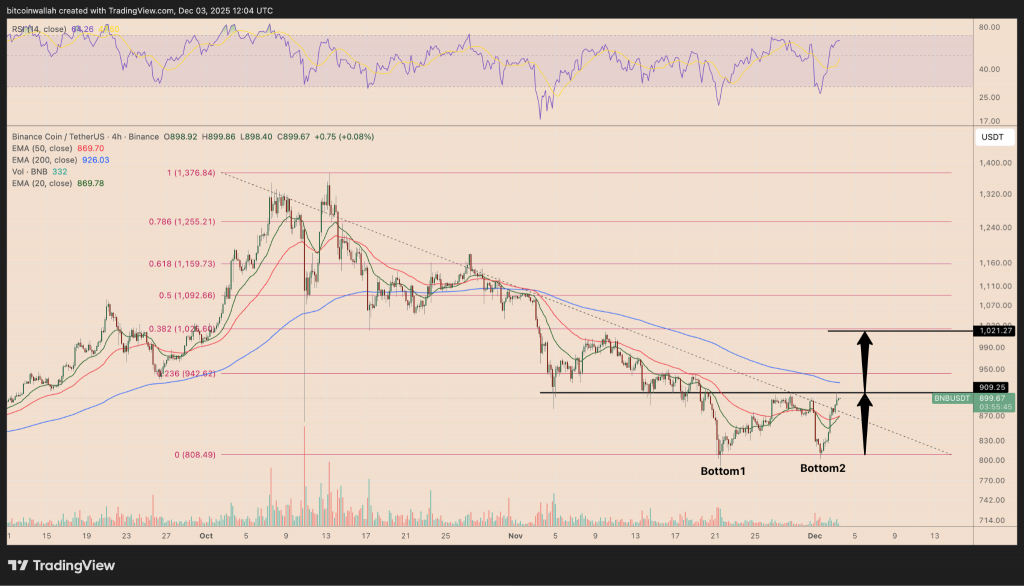
BNB reclaimed $900 this week after bouncing sharply from the $800–$820 demand zone, with multiple bullish technical structures now aligning behind a potential push back toward $1,000 in December. A double-bottom pattern on the 4H chart, combined with a clean breakout from a multi-week falling wedge, signals fading seller momentum and renewed appetite from dip-buyers. Liquidation heatmaps reveal over $112 million in short liquidations clustered near $1,020, suggesting a move toward that level could accelerate quickly if BNB breaks and holds above $900–$920.
BNB’s double-bottom and wedge breakout point toward a $1,000+ target. Source: Bitcoinwallah / TradingView
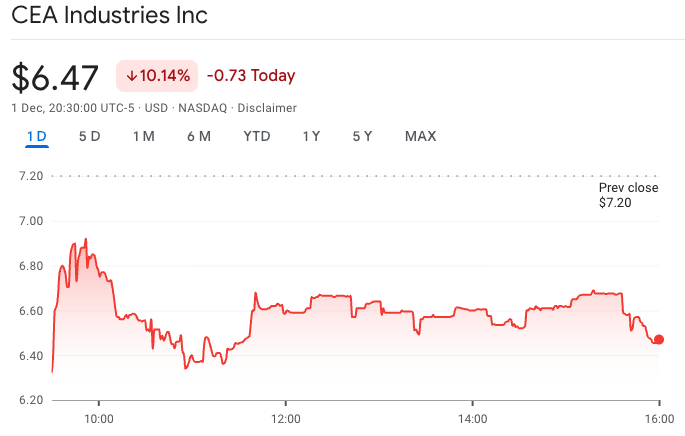
However, BNB’s narrative this week also revolved around turbulence in the corporate treasury sector. CZ’s YZi Labs launched a formal attempt to overhaul the board of CEA Industries — the largest public BNB-holding company — accusing management of destroying shareholder value after the stock plunged 89% from its July peak. YZi aims to reverse recent bylaw changes, expand the board, and install its own nominees, arguing that CEA has failed to execute on its strategy of becoming the leading BNB treasury company. CEA responded by reaffirming its commitment to the BNB strategy while opening a dialogue with YZi to resolve concerns.
CEA stock collapses as YZi Labs pushes for a board takeover. Source: Google Finance
CEA stock collapses as YZi Labs pushes for a board takeover. Source: Google FinanceDespite governance drama and broader market pressure, BNB has held up better than many large-cap assets this quarter, outperforming even as it trades well below its mid-October all-time high of $1,367. CEA’s reported holdings of 515,054 BNB at an average entry of $851 place its treasury slightly underwater, yet BNB itself remains up 17.8% year-to-date, reinforcing its relative strength during the latest downturn. If bullish technicals continue to hold — and especially if liquidation clusters begin to trigger — analysts say BNB could feasibly revisit the $1,020–$1,115 range before year-end.
If you are just starting out in crypto, it is advisable to stick to cryptocurrency projects that are less prone to volatility and are generally more established. While this approach does have a downside, as it becomes much more difficult to expect triple-digit or larger gains, the major upside is that you are not exposed to projects that have a chance of failing and, thus, losing your entire investment.
In order to identify projects that are stable and thus feature low volatility, you can start by following the parameters listed below:
The crypto asset has a market capitalization that places it into the cryptocurrency top 100 (roughly $200 million as of autumn 2026)
The crypto asset is available for trading on the best crypto exchange platforms and can be exchanged for fiat currencies
The crypto asset boasts healthy liquidity ($100M/day and more), which allows you to execute buy and sell orders quickly and without slippage
The crypto asset is part of a reputable crypto project with clear goals, a realistic roadmap, and products and services that look to address real-world problems
Some of the best cryptos to buy for beginners are those that follow the above criteria and have earned their standing in the crypto market due to robust security, popular products and services, and clear growth potential. Some beginner-friendly crypto investments are:
Bitcoin
Ethereum
Litecoin
Cardano
BNB
It is worth noting that cryptocurrency investments are inherently risky, even if you stick to the biggest and most reputable projects. The reason for this is simple – the crypto sector is relatively new, and the landscape might look completely different in the future.
Best crypto for long-term
When deciding which cryptocurrency to buy for the long term, it’s important to consider projects that are well-established, have a strong community, are highly liquid, have a large market cap, and have a clear reason for existing (such as solving a real-life problem, introducing new functionality, etc.). Without these characteristics, a project might fail to survive in the long term, rendering it a bad long-term investment.
It is worth noting that, typically, most long-term crypto investors are looking for projects that have the potential to generate decent returns but also provide a degree of investment stability. Roughly speaking, only the largest cryptocurrencies fit the bill, as others have a low market cap and liquidity that doesn’t bode well for a long-term commitment (unless you’re prepared to take on more risk).
In addition to Bitcoin and Ethereum, there are a number of other cryptocurrencies that fit the criteria of being low-risk, long-term crypto investments.
If you are planning to hold onto your digital assets for a longer period of time, it is best to take care of crypto custody yourself. Holding large amounts of crypto on an exchange can be risky, as we’ve seen over the years with the collapse of high-profile exchanges like Mt. Gox and FTX. Use one of the reputable crypto hardware wallets to store your crypto. Ledger hardware wallets, for instance, allow you to manage your crypto holdings easily and provide a much higher degree of security than crypto exchanges or even software crypto wallets.
Best place to buy crypto
One crucial aspect to consider when choosing which platform to use to buy crypto is the range of cryptocurrencies and trading pairs available. Since different exchanges support varying digital assets, it’s important to choose a platform that accommodates the specific cryptocurrencies you intend to trade.
Additionally, assessing an exchange’s liquidity and trading volume is essential. Higher liquidity generally results in improved price stability and faster trade executions. Furthermore, it is prudent to examine the fees charged by the exchange, encompassing deposit, withdrawal, and trading fees. Comparing fee structures across different exchanges can help you identify the most cost-effective option that aligns with your trading style. With that said, here are some of the best exchanges on the market right now:
Binance – The best cryptocurrency exchange overall
Kraken– A centralized exchange with the best security
By diligently considering these factors, you can make an informed decision and select a cryptocurrency exchange that meets your requirements for security, variety, liquidity, and affordability.
How we choose the best cryptocurrencies to buy
At CoinCheckup, we provide real-time prices for over 40,000 cryptocurrencies, with the list growing by dozens each day. As you can imagine, making a selection of a dozen top cryptocurrencies to buy out of such an immense dataset can be difficult and will for sure lead to some projects that should be featured being omitted. To minimize the chance of that happening, we follow certain guidelines when trying to identify the best cryptocurrencies to invest in.
Availability
One of the most important factors for any cryptocurrency investment is the crypto asset’s availability, meaning how easy it is to buy and sell it across various cryptocurrency exchanges. We tend to stay away from assets that are not available on major exchanges and require complex procedures to obtain.
Market Capitalization
Another important metric for identifying whether a crypto project is worth covering its market cap. A high market cap means that the project has reached a certain level of adoption from users, making it less risky to invest in.
Growth Potential
While this metric is mostly subjective, it is still an important metric on which we curate our selection. We won’t feature projects that we think are stagnating or have no real upside in the future.
Purpose and Use Case
We consider the purpose and use case of cryptocurrency, particularly in a real-world setting. Some cryptocurrencies focus on specific industries or applications, such as decentralized finance, gaming, or supply chain management.
Team and Development
The team and people involved in the project can tell you a lot about the potential of a particular cryptocurrency project. We examine the team’s experience, expertise, and track record and evaluate the development activity and updates to ensure the project is actively maintained and evolving.
The bottom line: What crypto should you buy right now?
The decision of which crypto to buy now is dependent on your own risk profile and investment goals. For some, investing in a crypto asset with a proven track record like Bitcoin is the only type of exposure to crypto they are willing to take on.
Meanwhile, those with a higher risk tolerance might see Bitcoin as too stable, looking instead toward newer and smaller projects that carry a higher degree of upside.
The Algorithm Alliance has established itself as a platform for deeper industry conversations at a time when artificial intelligence is moving rapidly from experimentation to real-world deployment. Focusing on AI, data science, and algorithmic innovation, the program unites experts building intelligent systems for business across industries.
Rather than following the rulebook of traditional tech events, The Algorithm Alliance is creating an environment that encourages critical thinking, technical exchange, and meaningful dialogue. It connects data scientists, machine learning engineers, researchers, and decision-makers who are actively shaping the practical operations of AI systems.
With AI becoming vital in enterprise systems and daily products, the discussions around them now include innovation and its issues, including but not limited to scalability and deployment, ethics, long-term impact, and more. The Algorithm Alliance moves away from surface-level talk and involves real-world challenges. It covers in-depth conversation about applications of AI to the real world, the complexity of scaling models, and accountability around the deployment of intelligent systems.
This is the process that keeps the Algorithm Alliance event true to its roots in the real world. It fosters an atmosphere where ideas are evaluated, assumptions are challenged, and solutions are refined through discussion.
The discussions at The Algorithm Alliance are based on current industry themes. Algorithms in modern AI systems represent a major area of focus. As models become more sophisticated, it becomes necessary to understand their behavior and improve their performance.
Data-driven decision-making also plays a vital part. Data is becoming increasingly important to organizations as a guide to their strategy, so understanding how data is collected, processed, and interpreted is key.
Challenges of scalability and deployment are similarly at the forefront of this issue. Moving from prototype to production remains one of the most difficult aspects of AI implementation. Conversations address infrastructure, cost, and reliability. We also consider the future of automation and intelligence. Part of this involves conversations about the evolution of AI systems and their interaction with human decision-making.
The structure of The Algorithm Alliance is intentionally designed to encourage participation.
Structured talks are included in sessions and invite audience input, followed by guided conversations and fireside chats with industry experts, along with open forums for discussion with attendees. Expert insights add another layer of context, and open discussions encourage the audience to add their perspective. Networking sessions also add more depth to the event, with a focus on interaction.
Attendees are invited to participate actively rather than passively consume information to deliver practical value.
The Algorithm Alliance is created for individuals who are directly involved in shaping AI strategies and implementations. This includes decision-makers in AI and technology, data leaders, and strategists responsible for guiding organizational direction.
From Singapore and Abu Dhabi to the glitz of Dubai, the Algorithm Alliance movement is officially going global, one city at a time.
The credibility of The Algorithm Alliance is reflected in the quality of its speakers and contributors. Past participants include Ferhat Doğru, CEO of Some Capital; Sergiu Vasilescu, Managing Partner at VD Law Group; and Yara Alatrach, Co-founder of EDNAS Academy.
Other notable contributors include Anton Mosharov of OmegaCloud.ai, Ben Owen of Atelic.ai, and Anton Reshetov from TheGarden and AI Salon Dubai.
The broader network also features voices such as May Ann Lim from the Asia Cloud Computing Association, Victor R. Ocampo from the Decentralised Identity Foundation, Ethan Seow from the Centre for AI Leadership, and Preetam Rao of Quill Audits.
This mix of founders, operators, and industry leaders makes sure that discussions are informed by real experience and diverse perspectives.
AI is entering a phase where execution matters more than experimentation. Organizations are looking for clarity on how to implement AI effectively and responsibly.
Events like The Algorithm Alliance play a key role in this metamorphosis. They help bridge knowledge gaps by bringing together professionals who are working on similar challenges.
Cross-industry collaboration is another important result. As AI continues to influence multiple sectors, the ability to learn from different perspectives becomes increasingly valuable.
Powered by Marketing Ninja
The initiative is supported by Marketing Ninja, which acts as a growth and ecosystem enabler. This partnership adds visibility to the conversations within the community and helps amplify their voice.
The Algorithm Alliance invites professionals to join a growing community focused on shaping the future of AI.
Join the conversation and contribute to the next phase of AI development.
Algorithm Alliance has returned, a builder-first stage for those ready to trade ‘talk’ for ‘real trajectory’. This is a highly focused ecosystem where data scientists, ML engineers, and researchers meet to move from theory to execution. As AI scales at breakneck speed, the demand for authentic, hands-on collaboration has never been more pivotal.
The Algorithm Alliance addresses this difference by creating a platform where technical minds can connect and work together in ‘real time’.
The Algorithm Alliance is built on a simple idea: Builders learn best by building. This belief shapes every piece of the experience. The approach moves away from passive listening and focuses on active participation. Attendees are encouraged to engage, question, and contribute.
This initiative prioritizes depth over surface-level panels, helping you navigate technical challenges. The conversations are practical, not theoretical.
Participants are also encouraged to contribute, which is further promoted through open mic segments and collaborative discussions. Such platforms allow followers to share ideas, solutions, and give feedback to fellow participants. This sets up an environment where knowledge progresses in several directions.
The structural aspect of The Algorithm Alliance is its strength. The core of the event consists of roundtables, technical discussions, and hands-on challenges. They will conduct relevant and in-depth conversations about the concerns in data science and machine learning that participants are familiar with. Topics can include model optimization, data infrastructure, and deployment challenges, with a focus on solutions that can be implemented immediately.
Previous editions of the event were a resounding success in Abu Dhabi, Dubai, and Singapore.
The builder-first mindset also encourages experimentation. Attendees are given space to test ideas, collaborate on solutions, and refine their approaches. With over 40 media partners, this event creates a fertile culture of active support and continuous learning.
The Algorithm Alliance is designed for individuals who are proactively building in the AI and data science space. This includes AI researchers, machine learning engineers, and data scientists working on real-world problems.
Startup founders can utilize the technical depth and professional knowledge from the broader data science ecosystem for better AI integration in their products. With researchers, founders, and builders redefining how algorithms and data science are applied in practice, this event unites a concentrated set of individuals with a singular motive of helping the field progress.
The structure is balanced against flexibility within the experience of the event. The panels and fireside chats offer real-world perspectives from experienced professionals, setting the foundation for serious exploration. This promotes visibility and knowledge exchange.
Networking sessions will link builders with similar interests and complementary skills. Collaborative problem-solving is a key part of the encounter. The participants work through problems, exchange ideas, and devise ways of solving them.
Learn, Build, Collaborate
Algorithm Alliance was built to combine technical brilliance with tangible results, bringing together data scientists and AI researchers to turn exploration into real-world impact.
Learn from experts.
Build during hands-on sessions and solve problems.
Collaborate to refine ideas and create better solutions.
The focus remains on real conversations instead of theoretical discussions. Community-led innovation drives the overall experience, making it relevant and adaptable.
Powered by Marketing Ninja
The initiative is powered by Marketing Ninja, which adds a strong growth and visibility layer to the ecosystem. This support helps amplify the community and ensures that valuable work gets the attention it deserves.
Join the Builder Ecosystem
The Algorithm Alliance is building a space that values action, collaboration, and continuous learning.
Jeopardy plays such an integral part in poker. You could argue that it is the main factor that has helped the game glide between such innovative and global mediums over the last 30 years.
While it has jumped between land-based, online, and cryptocurrency formats, none has necessarily replaced the others; it is the human angle and the excitement of outthinking someone with your strategy that have allowed the game to flourish in the modern age.
As algorithms, automation, and increasingly digital forms of the game continue to reshape the poker industry as we know it, many feel it will hit a ceiling where the game must have a human element, suspense, and jeopardy. For now, this is certainly the case, but what could this market look like in 10 or 20 years? Let’s take a look.
Balancing Innovation With Human Skill
There’s no doubt that cryptocurrency and blockchain ideas have given the poker industry plenty to think about. For international players, it has given them a route to receive payments without worrying about cross-border fees, and any issues or payments can be mapped and tracked through the blockchain. This transparency has allowed cryptocurrency poker platforms to become a genuinely new and inventive way for people to play the game.
Crypto poker enthusiasts have increasingly gravitated toward platforms such as Ignition Poker, making it a more familiar sight across the industry, particularly this decade thus far. It has helped counterbalance some of the more problematic aspects of the conventional game.
While there is plenty to be said about the atmosphere and energy of a traditional poker game in person, the presence of cryptocurrency and the blockchain has created accountability and transparency on a scale not seen before, both in conventional gaming and even in older online formats that handle fiat currencies.
The presence of the blockchain, and the fact that every transaction is logged and recorded on a public record that is available 24/7, is a gamechanger. Poker pros have voiced concerns about certain aspects of conventional gaming, their models, and who funds high-roller games. There can be a murky element to it, but with online poker that leverages crypto and the blockchain, the information is readily accessible to anyone.
Can Cryptocurrency Poker Dominate At Some Stage?
Despite cryptocurrency becoming one of the most talked-about areas of the financial world, some believe we are only seeing the tip of the iceberg in terms of mass adoption.
Stablecoins like USDT are used as a digital and onboarding currency for those wanting to access the market but prefer a currency they understand and that has parity with fiat.
Instead of needing to understand how the ETH blockchain or NFTs work, those with a general interest in crypto and an idea of how the blockchain works can draw parallels between fiat currencies and stablecoins.
The transparent, borderless, and decentralized elements of the blockchain and cryptocurrency give it a huge advantage over more conventional ideas, but without the mass adoption and waves of people deciding to use crypto instead of conventional payment options, then it’s quite a big leap to say it will surpass conventional payment options, given how deep-rooted they are in the broader poker gaming industry.
Drawing Parallels From Other Arenas
We have seen crypto whales, professional traders, and elite sportspeople try their hand at the poker table. The dynamic of cryptocurrency, and the way it has been designed with decentralization at the very basis of the invention, has brought down international barriers, in more ways than one, allowing the best players globally to face off.
Many professional athletes gravitate toward gambling, but particularly poker. It’s the combination of strategy, skill, and jeopardy that mirrors elite performance at the top of many industries and involves a complex web of psyching out your opponent, understanding psychology, and calculating rapid-fire odds.
Unlike every other facet of casino gaming, poker games can go on for a long time- hours; tournaments can last weeks; there are layers and layers of strategy and jeopardy. While AI might be able to play poker and read a game better than any human can, this has been the case for nearly a decade.
In addition, we have seen how supercomputers have beaten the best chess players for decades – it’s not a new phenomenon. Algorithms and automation will never be able to fully eclipse the jeopardy, skill and strategy that lies at the bedrock of all forms of poker.
Final Thoughts
As blockchain and cryptocurrency turn local poker communities into global hives of activity, the emergence of a digital log of all transactions and a form of payment that allows players to send money directly to each other’s wallets has the potential to become the digital pathways of future finance and poker gaming.
It still has a long way to go, and while convenience and demand will ultimately dictate the direction the market heads, a poker game without jeopardy or skill becomes stale quickly, whether you are a player or somebody who enjoys watching tournaments unfold.
No matter how impressive and ingenious technology grows, there will be no replacement for the jeopardy and high-octane energy of a poker game between elite players. When all is said and done, and the positives and negatives are balanced, this will be the main factor that ensures poker will be a staple of casino gaming for generations to come.
CoinTracking is one of the longest-running cryptocurrency portfolio and tax platforms on the market. Founded in 2012 and operated by Germany-based CoinTracking GmbH, the service has grown to more than 2.2 million registered users and supports over 400 integrations with exchanges, wallets and blockchains.
That longevity is particularly valuable when dealing with cryptocurrency taxes. Investors may need to reconstruct transactions dating back many years to calculate the cost basis of assets correctly. Since CoinTracking has existed through several crypto market cycles, it is particularly well suited to users with extensive historical trading records.
The platform isn’t limited to tax preparation. CoinTracking also includes portfolio monitoring tools, mobile apps, performance analytics and support for thousands of crypto assets. However, its tax functionality is where the service becomes especially comprehensive.
In this CoinTracking review, we’ll examine its tax reporting capabilities, supported jurisdictions, pricing structure, transaction import tools, support for DeFi and NFTs, AI features, Full-Service offering and security practices.
API, CSV, blockchain synchronization and Custom Importer
Data validation
Tools for detecting missing transactions, duplicates and balance inconsistencies
Free plan
Up to 200 lifetime transactions; no downloadable tax reports
License options
1-year, 2-year and lifetime
Transaction limits
Lifetime limits that do not reset annually
Security
ISO/IEC 27001:2017 certified, GDPR-compliant and read-only API connections
CoinTracking is essentially a combination of a crypto portfolio tracker and a cryptocurrency accounting platform.
Users can connect exchanges, wallets and blockchain addresses to consolidate their crypto activity in one place. Transactions can be brought into the platform through APIs, CSV files, blockchain imports and automatic synchronization. A Custom Importer is available when a particular platform doesn’t have its own dedicated integration.
Once data is imported, users can monitor balances, realized and unrealized gains and portfolio performance. CoinTracking’s mobile apps for iOS and Android offer live balances, charts, widgets and support for more than 4,000 cryptocurrencies.
The platform becomes much more detailed when users begin preparing taxes. It provides country-specific tax reports, multiple cost-basis methods and tools for validating transaction histories before calculations are finalized.
Who is CoinTracking best suited for?
CoinTracking can accommodate everything from relatively simple buy-and-hold portfolios to highly complicated transaction histories.
Casual investors can use its free portfolio tracking features and move to a paid plan if they later need downloadable tax reports. Meanwhile, people who have held and traded cryptocurrency for many years may find CoinTracking especially appealing because one subscription can cover multiple tax years.
The service is also well equipped for active crypto users. DeFi transactions, NFTs, staking, mining, derivatives, margin trading and other more complicated activities can all be incorporated into an account.
Professional users aren’t overlooked either. CoinTracking offers Corporate Accounts for accountants, tax advisors and businesses that need to manage multiple client portfolios. A Data API is also available for programmatic access to account information such as trades and balances.
Crypto tax reporting across 22 countries
A major advantage of CoinTracking is that it doesn’t rely exclusively on a generic cryptocurrency tax report.
The platform currently provides dedicated tax reports for 22 jurisdictions:
United States, United Kingdom, Germany, Austria, Switzerland, France, Netherlands, Belgium, Italy, Spain, Portugal, Ireland, Czechia, Poland, Denmark, Sweden, Norway, Finland, India, Australia, New Zealand and Canada.
These reports are designed around the rules of the corresponding jurisdiction rather than simply applying the same calculation everywhere. Depending on the country, CoinTracking can account for considerations such as holding periods, crypto-to-crypto transactions, different types of income and locally accepted accounting methods.
Users who need a more general calculation can also access methods including FIFO, LIFO, HIFO, ACB, AVCO and HMRC.
This flexibility becomes particularly useful for people with complicated portfolios or those who need to reconstruct several years of historical cryptocurrency activity.
CoinTracking has US crypto investors covered
CoinTracking provides comprehensive tax report coverage for US-based crypto investors.
For US taxpayers, CoinTracking generates Form 8949 with section assignment, Form 1040 Schedule D, FBAR (FinCEN Report 114) and Form 8938, alongside a direct TurboTax export.
The Form 8949 output also includes 1099-DA flagging for the 2026/2027 season, so users can reconcile their own records against broker reporting before filing
Data validation is a major part of the platform
Importing transactions is only the first part of preparing an accurate cryptocurrency tax report.
Missing transfers, duplicate trades and incorrect transaction classifications can significantly affect the final calculation. CoinTracking therefore includes several tools designed to help users identify problems before generating their reports.
These include ValiCheck pages, the Missing Transactions Report, Transaction Flow Report, duplicate filtering, balance checks and a Spam Center.
For users combining records from several centralized exchanges, self-custody wallets and blockchain applications, these validation tools can be almost as important as the tax calculator itself. A sophisticated accounting method won’t produce an accurate result if the transaction history feeding into it is incomplete.
More than 400 integrations for importing crypto activity
CoinTracking supports more than 400 importers covering exchanges, wallets and blockchains.
Transactions can be added through APIs, CSV uploads and automatic blockchain synchronization, while the Custom Importer provides another option for services that don’t have a dedicated connection.
Broad integration support is particularly valuable for investors whose activity is scattered across many platforms. Instead of manually consolidating years of records into a spreadsheet, users can bring much of their historical activity directly into CoinTracking.
The platform’s ability to accommodate older transactions also complements its long operating history. This makes CoinTracking particularly relevant for investors who started buying or trading cryptocurrency many years ago.
CoinTracking pricing explained
CoinTracking’s pricing works somewhat differently from many crypto tax platforms.
Instead of selling access to a report for one particular tax year, CoinTracking subscriptions cover the account and its transaction history. This means users can prepare reports for earlier tax years without buying a separate package for every year.
The free account supports portfolio tracking and up to 200 lifetime transactions, although downloadable tax reports are reserved for paid users.
The main annual plans are:
Starter – from $49 per year: Includes tax report functionality and supports up to 200 transactions.
Pro – from $169 per year: Raises the lifetime transaction allowance to 3,500.
Expert S – from $259 per year: Supports up to 20,000 transactions.
Expert M – $349 per year: Supports up to 50,000 transactions.
Expert L – $459 per year: Supports up to 100,000 transactions.
Unlimited – $899 per year: Removes the transaction limit, supports up to 100 wallets and includes priority support.
CoinTracking also provides a seven-day trial that allows unlimited transaction imports. Producing and downloading the final tax report still requires a paid plan.
Payment methods include credit cards, PayPal and Klarna, alongside Bitcoin and more than 160 additional cryptocurrencies.
Here is a full breakdown of CoinTracking’s current pricing structure:
Lifetime plans could be attractive for long-term crypto users
Perhaps the most unusual aspect of CoinTracking’s pricing is the availability of two-year and lifetime licenses.
Lifetime access isn’t common among cryptocurrency tax services, most of which charge users on an annual or tax-year basis. For someone who expects to keep investing in crypto for the foreseeable future, a lifetime CoinTracking license can therefore change the economics considerably.
Instead of paying for tax software every year, users can make a larger upfront payment and continue using the platform for future tax periods.
There is one important caveat: CoinTracking’s transaction allowances are also calculated on a lifetime basis.
Transactions don’t disappear from the limit when a new tax year begins. An account containing 2,000 historical transactions that receives another 1,000 transactions will be treated as having 3,000 transactions in total.
Buy-and-hold users might therefore get substantial value from a lifetime license, while high-frequency traders need to consider how quickly their accumulated transaction history could move them into a higher tier.
Support for DeFi, staking, NFTs and derivatives
Cryptocurrency accounting gets substantially more complicated once users venture beyond simple spot trades on centralized exchanges.
CoinTracking can track a broad selection of crypto transaction types, including staking, mining, masternodes, liquidity pools, DeFi activity, NFTs, loans, margin trades, derivatives and futures.
Its dedicated NFT Center provides additional information about non-fungible tokens, including token IDs, acquisition dates, purchase prices and the wallets where individual assets are held.
This combination of broad transaction support and hundreds of import connections makes CoinTracking a strong option for users who have interacted with multiple blockchains and decentralized protocols.
Once that activity is imported, CoinTracking’s validation tools can also be used to search for missing transfers, duplicate entries and other inconsistencies that could distort tax calculations.
AI Tax Saver adds tax planning tools
CoinTracking isn’t designed exclusively for preparing reports after a tax year has ended.
Its AI Tax Saver feature attempts to help users understand the potential tax consequences of transactions before they make them.
The tool analyzes a user’s actual CoinTracking portfolio and tax lots instead of merely providing generic tax information. For example, users can simulate a FIFO sale and view the estimated proceeds, cost basis and resulting realized gain.
AI Tax Saver can also identify assets approaching important holding-period thresholds, highlight unrealized losses that could potentially be relevant for tax-loss harvesting and show how much of a locally applicable tax allowance has already been used.
These features could make CoinTracking more useful as a year-round tax planning platform rather than something users only open shortly before a filing deadline.
However, CoinTracking describes AI Tax Saver as an assistance tool and not a substitute for professional tax advice.
Full-Service is available for users who want expert help
Even with strong import and validation tools, reconstructing years of cryptocurrency transactions can require considerable work.
CoinTracking’s Full-Service offering is intended for users who would prefer to hand over some or all of the process. The service is available in more than 25 countries.
Depending on the package, CoinTracking can help users get started with the platform, review an existing account or handle tasks such as importing transactions, checking data and preparing tax reports.
Its Basic, Advanced and Express Account Service options can also support more difficult histories involving DeFi, NFTs, margin trading and futures.
In certain jurisdictions, CoinTracking can additionally connect clients with certified cryptocurrency tax professionals who can prepare or file their taxes.
This provides another route for users who have complicated crypto records but don’t want to become experts in cryptocurrency accounting themselves.
Security and privacy
Tax software can contain a highly detailed record of a person’s financial activity, making security particularly important.
CoinTracking is ISO/IEC 27001:2017 certified and stores its servers within the European Union. As a German company, it also operates under GDPR requirements, and sensitive information stored on the service is encrypted.
API connections used to synchronize exchanges are read-only. As a result, API keys added to CoinTracking aren’t able to execute trades or withdraw cryptocurrency from connected accounts.
CoinTracking also says its employees cannot access or decrypt these API keys.
Another notable privacy feature is that an email address isn’t mandatory when opening a CoinTracking account. Users who want to minimize the amount of personally identifying information attached to their crypto portfolio therefore have the option of registering without providing one.
Comparison of security features between CoinTracking and multiple competitors. Source: CoinTracking
CoinTracking pros and cons
CoinTracking’s strengths are most apparent for long-term users and people with complicated transaction histories, although the depth of the platform can also introduce additional complexity.
Pros:
ChangeNOW supports more than 1,500 cryptocurrencies and more than 110 blockchains, including a wide range of cross-chain swaps.
ChangeNOW’s core exchange doesn’t store customer funds, allowing users to retain control of their assets.
Transactions can start from as little as $2, while ChangeNOW doesn’t impose an upper exchange limit.
ChangeNOW says most exchanges are completed in less than one minute.
Users can choose between locking in an exchange rate or using a rate that follows market movements.
The VIP subscription costs $0 and still provides 0.1% swap cashback and access to unlimited crypto loans.
In addition to swapping, ChangeNOW offers crypto lending, a wallet, portfolio tracking, payments, blockchain nodes and integration tools for businesses.
Customer assistance is available around the clock.
Cons:
Emerald costs $15 per month, while the Brilliant plan costs $100 per month.
Both the VIP and Emerald plans provide 0.1% cashback on swaps.
The lending product uses a fixed 50% LTV and fixed 10% APR rather than allowing users to choose from several lending structures.
Fiat purchases are provided through partners such as Transak, Simplex, Banxa and Guardarian rather than directly by ChangeNOW.
Although most transactions are fast, confirmation speeds can affect how quickly an exchange or loan is completed.
Is CoinTracking worth it?
CoinTracking is particularly compelling for investors who need more than a basic cryptocurrency tax calculator.
Its extensive import functionality and support for complex crypto activities make it capable of dealing with transaction histories spread across centralized exchanges, blockchains, wallets, DeFi protocols and NFT platforms. The validation tools are another important advantage, as they give users several ways to identify problems in their imported data before generating a tax report.
CoinTracking’s approach to pricing also distinguishes it from many competitors. A subscription isn’t restricted to a single tax year, and users can choose between annual, two-year and lifetime access. This could provide significant value for people who have been investing in cryptocurrency for years or expect to continue doing so over the long term.
The biggest consideration is complexity. CoinTracking contains a substantial number of reports, settings and transaction details, which can make it less immediately approachable than simpler tax tools. Its lifetime transaction limits also mean active traders should estimate their historical and future transaction volumes carefully before choosing a plan.
For long-term crypto investors, users who need to prepare tax reports covering several years and people with complicated DeFi or multi-platform transaction histories, CoinTracking offers one of the most extensive sets of crypto accounting features available.
We’ve rolled out a major update to CoinCheckup, headlined by a completely redesigned crypto Analysis page (available for all coins on the site – for example, Bitcoin Analysis).
The new page is built to make technical and market analysis much easier to understand at a glance, while still providing enough detail for users who want to dig deeper.
Alongside the redesign, we’ve also upgraded CoinCheckup to Next.js 16 and React 19, added 14 new languages, improved translations across the site, and made charts much easier to use on mobile.
A completely new Analysis page
The biggest visible change is our new Analysis page.
Instead of presenting technical indicators as a collection of isolated numbers, the new design tries to answer a more useful question: what do all of these indicators actually say about the asset right now?
At the top of the page, you’ll now find an Investment Score that gives a quick overview of the asset’s current setup, along with the main factors supporting it and the biggest risks.
For example, the page can highlight whether momentum, moving averages or volume are supporting the current trend, while also pointing out issues such as elevated volatility or overextended momentum.
Understand the current market state
We’ve also introduced a new Market State Summary.
This groups the current market environment into an easy-to-understand regime, such as a bullish but volatile market, and includes a confidence score explaining how strongly the data supports that classification.
More importantly, the page explains why the asset is in that state and suggests the type of strategy that may fit the current conditions.
Below that, you can quickly check separate summaries for:
Trend
Momentum
Volatility
Key support, resistance and active price zones
Better support and resistance analysis
Support and resistance also received a major upgrade.
Instead of showing only individual price levels, the Analysis page now identifies price zones and provides additional context such as their strength, number of touches, time windows and the most recent interaction with the zone.
The page then turns these levels into three straightforward scenarios:
Bullish: what would need to happen for the setup to become more positive.
Bearish: which support level would need to break for downside risk to increase.
Neutral: the range in which the asset could continue trading without a clear breakout.
Technical indicators with actual explanations
Technical indicators are still available, but we’ve made them much easier to interpret.
Instead of only showing values such as RSI, SMA or MACD, each indicator now includes a signal and a plain-language explanation.
For example, the page can explain that an elevated RSI suggests momentum may be stretched, or that trading above a moving average supports the current trend.
This should make the page considerably more useful for users who don’t want to memorize what every technical indicator means.
See which cryptocurrencies are moving together
The redesigned page also includes an improved correlation section.
You can see which cryptocurrencies have recently been moving most closely with the selected asset, as well as which assets have shown the strongest negative correlation.
This provides another way to understand how an asset is behaving relative to the broader crypto market.
Charts are now easier to use on mobile
We’ve also fixed one of the more frustrating parts of browsing chart-heavy pages on a phone.
You can now scroll vertically across charts without the chart capturing your touch gesture.
Previously, swiping over an interactive chart could interfere with normal page scrolling. The new behavior gives priority to regular vertical scrolling on touch devices while keeping chart interactions available when you actually want to use them.
It’s a small change on paper, but it makes browsing CoinCheckup on mobile feel much smoother.
CoinCheckup now supports 14 more languages
CoinCheckup is becoming much more accessible globally.
We didn’t just add new languages, though. We also retranslated the existing interface text across all supported languages and improved our translation tooling so future updates can be localized more consistently.
A major technical upgrade behind the scenes
Finally, CoinCheckup has been migrated to Next.js 16 and React 19.
Most users won’t notice this change directly, but it gives us a more modern technical foundation for future development and makes it easier for us to continue improving performance, maintainability and the overall experience across the site.
Together, these changes represent one of the larger CoinCheckup updates we’ve shipped recently — with the new Analysis page being the most visible part of it.
Take a look at the new Analysis page and let us know what you think.